
Plug-in solar panels in the UK: how they work and whether they're worth it
Compliant plug-in solar is now allowed in Great Britain, but registration, permissions and safety checks still apply.
Contents
- 1.Introduction to plug-in solar
- 2.What are plug-in solar panels and how do they work?
- 3.The 27 August 2026 rule change explained
- 4.Are plug-in solar panels worth it?
- 5.Electrical safety and checking your home's wiring
- 6.Permissions, property types, and physical safety
- 7.Plug-in solar vs professionally installed rooftop solar
- 8.How to register your plug-in solar panel
- 9.Final thoughts
- 10.FAQs
Introduction to plug-in solar
Plug-in solar can reduce daytime electricity imports at a lower entry cost than rooftop solar, but it is only worthwhile where the home, location and usage pattern are suitable.
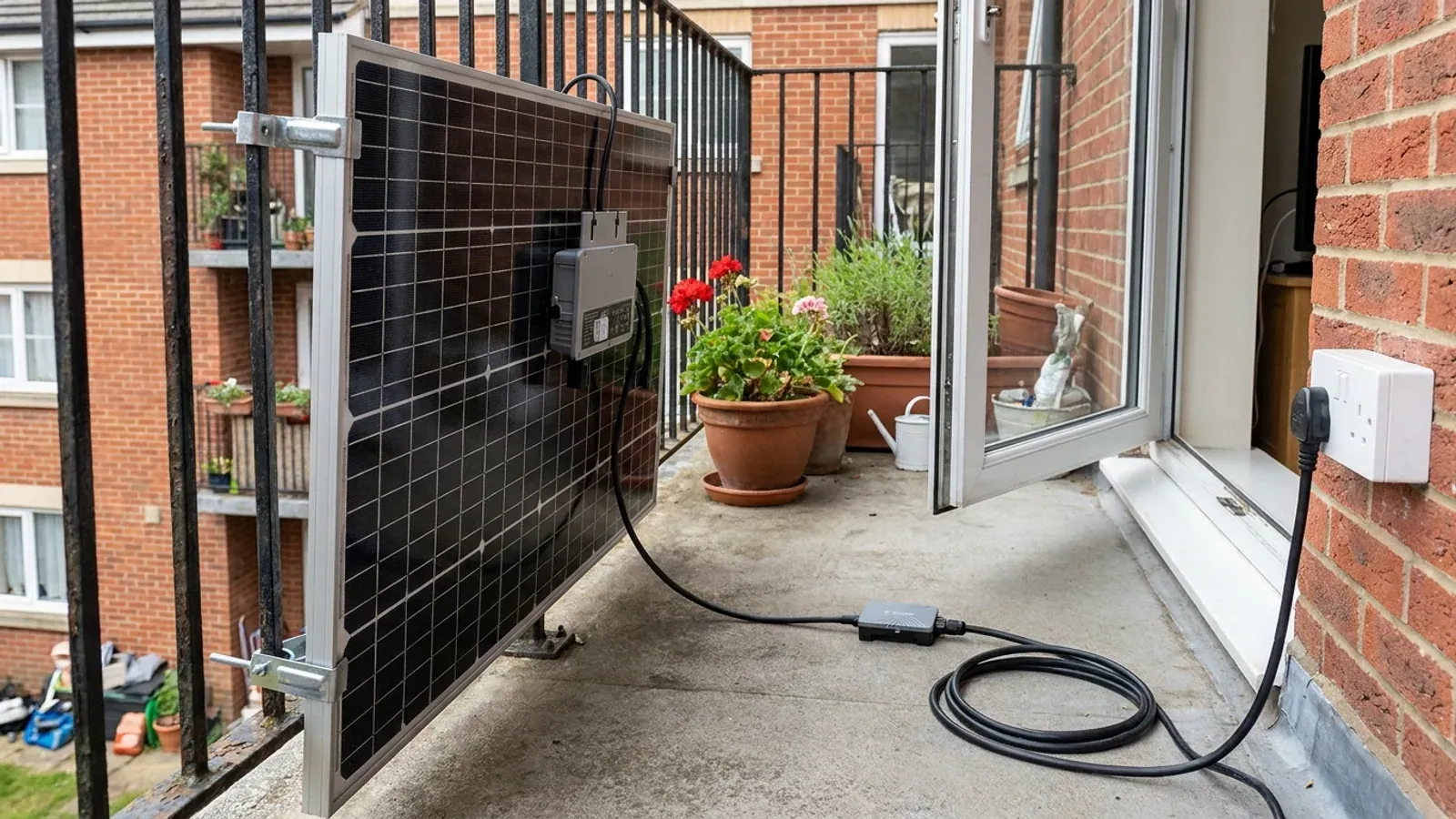
Plug-in solar, sometimes called balcony solar, is a small solar photovoltaic system designed to connect to a suitable household socket. It gives people who cannot fit a full rooftop array another way to generate some electricity at home.
The change does not make every kit sold online compliant or every property suitable. Electrical protection, a direct socket connection, safe mounting, registration and permissions can all affect whether a device is appropriate. Renters and leaseholders should settle the property questions before spending money.
Use our referral link, and we'll both get £50 credit once your switch is complete.
Existing customer? Find out how you can benefit too. T&Cs apply (only one switching offer per household)
What are plug-in solar panels and how do they work?
A compliant device includes at least one solar panel, a grid-following microinverter, the manufacturer-supplied connection lead and plug, and a mounting system. The panels produce direct current electricity. The microinverter converts it to alternating current that can supply loads in the home, reducing the amount imported from the grid at that moment.
When generation is higher than the electricity being used, surplus power can flow to the grid. The device is not a backup supply: its inverter is designed to stop exporting when the grid supply is lost.
The output limit
The current route limits the device to 800W of AC output. The combined rating of the panels may be higher because the microinverter caps what reaches the socket. Energy Saving Trust advises speaking to a qualified electrician where total panel power is above 960W, as well as where the wiring or consumer unit is uncertain.
The route covers solar-only devices. Plug-in batteries and plug-in solar products integrated with batteries are outside it. A separately installed battery is a different electrical project and should not be treated as an accessory that can simply be added to the plug-in device.
The 27 August 2026 rule change explained
The rule change created a route for compliant plug-in solar devices to use a standard UK plug and socket. It applies in Great Britain: England, Scotland and Wales. Energy Saving Trust says plug-in solar is not currently permitted for use in Northern Ireland.
Check the complete device, not just the advert
Before buying, check the specific device on the ENA Connect Direct low-carbon technology device register. Compliance applies to the complete product supplied for this use, including its inverter, manufacturer-fitted plug and mounting system. A generic balcony kit, a separately sourced inverter or a product carrying only a seller's claim is not enough evidence.[1]
Do not modify the device, replace or alter its plug, combine separate kits, or link devices together. Those changes take it outside the tested complete-product arrangement and can undermine the electrical safety assumptions behind the new route.
Are plug-in solar panels worth it?
Whether plug-in solar is worth buying depends more on the installed price, location and self-consumption than on the headline panel rating. Compare the price of the complete compliant device, mounting equipment and any electrician or permission-related work. Do not use the price of an unapproved panel-and-inverter bundle as though it were equivalent.
The government says a device could provide up to 20% of an average home's electricity use and save up to £110 a year. These are upper-end estimates, not a promise. Shading, panel angle and direction, local weather, electricity rates and the amount used during daylight all change the result.
Estimate value from the electricity you will actually use
Start with a credible annual generation estimate for the proposed position. Then estimate how much of that generation will coincide with your normal household demand. The value of self-consumed electricity is that amount multiplied by the import rate you avoid. Keep export separate, because an exported unit is not automatically worth the same as an imported unit.
Do not assume Smart Export Guarantee payments will be available. Suppliers set their own application requirements within the scheme rules and may ask for suitable export metering and installation certification. Ask the intended SEG supplier whether it accepts the exact plug-in arrangement before including export income in a payback estimate.
Electrical safety and checking your home's wiring
A device being designed for self-installation does not prove that the existing electrical installation is suitable. Energy Saving Trust says to involve a qualified electrician if the consumer unit has older rewireable fuses, the condition of the wiring is uncertain, a socket must be installed or moved, or total panel power is above 960W. Electrical Safety First takes the more cautious position of recommending an assessment by a competent electrician before purchase for every home.
Consumer unit and circuit protection
Modern consumer units commonly use RCDs or RCBOs alongside circuit breakers. Older or unsuitable protection may not behave as expected with electricity flowing from the device into the circuit. Do not infer suitability from the age of the property alone. If labels, device types or wiring condition are unclear, ask a qualified electrician to assess them.
Use a suitable socket circuit
Connect the device directly to a suitable socket with the manufacturer-supplied plug. Energy Saving Trust says the socket must be on a circuit that does not also supply lighting or hardwired equipment such as a boiler or cooker. An outdoor socket must be suitable for outdoor use and installed by a qualified electrician.
Follow the manufacturer's instructions for testing protective devices and for disconnecting the system. If a test fails, the plug, cable or inverter is damaged, or a protective device trips repeatedly, unplug the system if it is safe to do so and seek qualified advice.[1]
Permissions, property types, and physical safety
Settle ownership, planning, building-safety and insurance questions before buying. A removable-looking panel can still affect an external wall, balcony, communal area, fire assessment or weatherproofing.
Plug-in solar vs professionally installed rooftop solar
Plug-in and rooftop solar solve different problems. A plug-in device has a lower output and can suit a household that wants to reduce some daytime imports without commissioning a full roof installation. Rooftop solar can support a much larger share of demand, but needs a suitable building, a designed electrical connection and a larger budget.
| Feature | Plug-in solar | Rooftop solar |
|---|---|---|
| Connection | Manufacturer-supplied plug into a suitable socket | Fixed electrical connection designed for the installation |
| Current route | Up to 800W AC and one device per household | System size and connection process depend on the installation and network rules |
| Installation | Designed for ordinary-person installation where the home and position are suitable | Usually designed and installed professionally; electrical connection needs competent work |
| Battery options | Plug-in batteries and integrated plug-in solar-battery devices are outside this route | Can be designed with compatible battery storage |
| Moving home | May be movable if permissions, mounting and the next property allow it | Normally a permanent part of the property |
| Export payments | Check eligibility with the intended SEG supplier | Established route where metering and certification requirements are met |
A home that already has rooftop solar or a battery is not automatically barred from adding a plug-in device. Energy Saving Trust says this is usually possible, but advises checking with the original installer or a qualified electrician. A change to total generation or export may also need DNO consideration, so do not connect first and investigate later.
How to register your plug-in solar panel
Registration after installation is a legal requirement. Use the UK Plug-In Solar Registration website linked from current Energy Saving Trust guidance. The service asks for identifying details such as your postcode and the device make and model so the relevant Distribution Network Operator can record the connection.
Registration is separate from checking that the product is compliant and the home is suitable. Completing the form does not retrospectively approve an unlisted device, an unsafe circuit or a mounting position installed without the necessary permission.
Final thoughts
Plug-in solar can be worthwhile for a suitable Great Britain household that will use electricity during daylight, but the decision starts with compliance and property checks rather than a headline saving.
First check the exact device on the compliance register. Then check the proposed position, property permissions, consumer unit and socket circuit. Price the complete compliant arrangement, including any electrician or mounting work, before estimating payback.
Use the government's up-to saving only as a scenario. A household with an unshaded position and regular daytime demand may get more value than one with a shaded balcony and little daytime use. If the checks remain uncertain, pause the purchase and get the relevant professional or property advice.
Frequently asked questions
Can I plug in more than one kit?
Current guidance allows one plug-in solar device per household. Do not connect multiple kits, even on different sockets, because that falls outside the tested safety arrangement behind the new route.
Will plug-in solar work during a power cut?
Not as a backup supply. The grid-following inverter is designed to stop exporting when the mains supply is lost, helping prevent the local circuit from remaining energised.
Can I use an extension lead?
No. Current consumer guidance says to connect the manufacturer-supplied plug directly to a suitable socket, without extension leads, adaptors, altered plugs or smart plugs.
Is every balcony solar kit sold online compliant?
No. Check the exact complete device on the ENA Connect Direct low-carbon technology device register. A product description, CE or UKCA marking, or a listed inverter on its own does not establish that the whole plug-in arrangement meets the current route.
Can I add a plug-in battery?
Plug-in batteries and plug-in solar devices integrated with batteries are outside the new solar-only route. Get qualified advice for a separately installed battery system and do not modify the plug-in solar device.
Do I need an electrician?
The products are designed for self-installation where the home is suitable, but official advice is cautious. Energy Saving Trust lists situations that require qualified advice, while Electrical Safety First recommends a competent electrician assess every home before purchase.
Related reviews and comparisons
Solar Panel Cost Calculator
Solar Panel Cost Calculator. Estimate the cost, savings, and payback period of installing solar panels based on your region, usage, and roof details. Our Solar Panel Calculator helps you estimate the cost of installing solar panels and how much you could save on your energy bills in the UK. It shows
Try calculator →Prime Outgoing Octopus prices
A fixed-term export tariff that pays a higher rate from 4pm to 7pm and a lower rate at other times.
Read more →Octopus Power Pack prices
A specialist vehicle-to-grid add-on for compatible electric cars and bidirectional charging equipment.
Read more →Solar Panel Costs per kW
DESNZ solar installation costs by DNC size band and financial year, with the published median and mean labelled separately
Read more →Octopus Flux prices
An import and export pair built for homes with solar and a battery.
Read more →Related guides

What Gas and Electricity discounts are available for the disabled?
Managing energy bills is a major challenge for many households. For people living with a disability or a chronic medical condition, the costs are often much higher. Running medical equipment, keeping the heating on for longer, and spending more time at home all push up energy use. The disability equ
Read guide →
Are there Energy tariffs for pensioners?
When you retire, adjusting to a fixed monthly income can be a shock, especially when regular household bills continue to rise. Because older adults often spend more time at home and may need to keep the heating on for longer to stay well, energy costs usually make up a large part of their monthly bu
Read guide →
Octopus Energy Smart Meter: Installation, Readings and Tariffs
Upgrading to a smart meter changes how you manage your home energy. Instead of taking manual readings in the dark, a smart meter sends your usage directly to your supplier. For customers of Octopus Energy, the UK's largest energy supplier, getting a smart meter is also the key to unlocking their spe
Read guide →
Written by
Rob Gibbs
Hi, I'm Rob, and I run Energy-Review.co.uk. I initially started this project in 2018 when I was looking to switch energy suppliers and found there wasn't a website that provided simple, data-backed reviews on all the suppliers available. Since then, I have spent a lot of time (too much, some may say!) looking at all publicly available data about each supplier and writing reviews using this information. These reviews are updated as regularly as possible, and any data is backed up by a source where necessary. I have also started writing guides on various energy-related topics, which hopefully you will find useful. If you find any issues, please use our contact form to let us know.