
Should I fix my energy price/deal?
With the October 2026 price cap confirmed to rise to £1,723, fixing your energy tariff now could protect you from higher winter bills.
Contents
- 1.Should I fix my energy deal?
- 2.The latest price cap changes explained
- 3.What does fixing your energy deal mean?
- 4.Should you fix your energy bills right now?
- 5.The pros and cons of fixing your energy
- 6.Understanding exit fees and contract terms
- 7.What happens if energy prices fall next year?
- 8.How the new VAT rules affect your bills
- 9.How to compare deals and switch supplier
- 10.The final verdict on fixing your energy
- 11.FAQs
Should I fix my energy deal?
Energy prices are on the move again. With Ofgem confirming that the price cap will rise in October 2026, many households are looking at their options. If you are on a standard variable tariff, your rates will go up just as the weather turns cold and you start using more heating.
If you can find a fixed tariff that sits below the confirmed October price cap of £1,723, it is worth switching now to lock in cheaper rates for winter.
Deciding whether to fix your energy prices comes down to weighing the certainty of a locked-in rate against the risk of missing out if prices fall later. This guide explains how the upcoming price cap changes affect your bills, how fixed tariffs work, and what you need to check before you sign up for a new deal.
Use our referral link, and we'll both get £50 credit once your switch is complete.
Existing customer? Find out how you can benefit too. T&Cs apply (only one switching offer per household)
The latest price cap changes explained
To decide if you should fix, you first need to know what you will pay if you do nothing. Most homes in Great Britain are on a standard variable tariff. This means your energy rates are controlled by the Ofgem price cap, which changes every three months.
Right now, the price cap is set at £1,663 a year for a typical dual-fuel household paying by Direct Debit. This current rate applies until 30 September 2026. However, on 26 August 2026, Ofgem confirmed the new cap for the final three months of the year. From 1 October to 31 December 2026, the cap will rise to £1,723. This is an increase of 4%, which adds roughly £60 a year to a typical bill.
It is important to remember that the October rates are not active yet. Until the end of September, you are still paying the lower current rates. But the October rise is locked in, driven largely by higher wholesale gas prices.
Looking further ahead, analysts at Cornwall Insight currently forecast that the price cap will rise again in January 2027. They predict an increase of about 9%, which would take the typical annual bill to roughly £1,872. While January is still a forecast and could change, the trend suggests energy will be more expensive during the coldest months of the year.
What does fixing your energy deal mean?
When you take out a fixed energy tariff, the supplier agrees to charge you the same unit rates and standing charges for the length of the contract. This is usually 12 months, though some suppliers offer 15-month or 24-month deals.
Fixing gives you certainty. No matter what happens to the Ofgem price cap or global wholesale energy markets, the price you pay for each unit of gas and electricity will not change until your contract ends. This makes it much easier to budget for your winter heating.
However, fixing your tariff does not mean your monthly bills will be exactly the same all year round. You still pay for the energy you actually use. In winter, when your heating is on, your bills will be higher than in summer. The fixed part is simply the price of the energy itself, not the final total.
If you do not choose a fixed deal, you will stay on your supplier's standard variable tariff. This means your rates will go up in October, and they will change again in January, April, and July next year depending on what Ofgem decides.
Should you fix your energy bills right now?
The decision to fix comes down to comparing the fixed deals available today against the confirmed October price cap of £1,723. Because we know prices are going up in October, and are forecast to rise again in January, a good fixed deal can save you money over the winter.
Consumer groups generally suggest that if you can find a fixed tariff that costs less than the new October cap, it is a sensible time to switch. Even a deal that matches the £1,723 cap offers value, because it protects you from the predicted 9% price rise in January 2027.
There are currently fixed deals on the market that beat the incoming cap. For example, our database shows that Fuse Energy offers a 15-month fixed deal (the August 2026 Fixed V4) with an electricity unit rate of 22.86p per kWh and a gas unit rate of 6.78p per kWh. Both of these are comfortably cheaper than the October price cap averages of 26.32p for electricity and 7.97p for gas.
If you switch to a fixed deal that is cheaper than the October cap, you might pay slightly more for the few weeks left in September compared to the current £1,663 cap. But you will quickly start saving money from 1 October when the rest of the market sees their rates go up.
The pros and cons of fixing your energy
Locking in an energy tariff is a commitment. Before you sign up, it helps to weigh the clear benefits against the potential downsides.
The main risk of fixing is that energy prices are unpredictable. While forecasts currently point to a rise in January 2027, the market could change. If global events cause wholesale gas prices to drop sharply, the Ofgem price cap could fall in April 2027. If you are locked into a 12-month fix, you would not benefit from those lower rates unless you paid to leave your contract.
Understanding exit fees and contract terms
If you decide to fix your energy deal, you need to check the exit fees. An exit fee is a charge your supplier applies if you switch to a different tariff or a different supplier before your contract ends.
These fees are usually charged per fuel. For example, a supplier might charge £50 for gas and £50 for electricity, meaning it would cost you £100 to leave a dual-fuel contract early. Some longer fixes, such as 15-month or 24-month deals, can have even higher exit fees. The Fuse Energy 15-month fix mentioned earlier carries a £100 exit fee per fuel.
Exit fees matter because they act as a barrier if prices drop. If the price cap falls next spring and you spot a much cheaper deal, you will have to calculate whether the savings from switching outweigh the cost of the exit fees.
There are some rules that protect you. Under Ofgem regulations in Great Britain, suppliers cannot charge you an exit fee if you switch in the final 49 days of your fixed contract. This gives you a wide window to shop around and lock in a new deal before your current one expires. You also get a 14-day cooling-off period when you first sign up. If you change your mind within those first two weeks, you can cancel the switch without paying a penalty.
What happens if energy prices fall next year?
The main risk of fixing your energy tariff is that wholesale prices are unpredictable. While forecasts currently point to a 9% rise in January 2027, the energy market can change quickly. If global events cause wholesale gas prices to drop sharply over the winter, the Ofgem price cap could fall in April 2027.
If you are locked into a 12-month or 15-month fixed deal, your rates will stay the same even if the price cap drops. You would not automatically benefit from those lower rates. If the new price cap falls significantly below your fixed rate, you might find yourself paying more than people on a standard variable tariff.
In that situation, you would need to do some maths. You would have to weigh the cost of paying your supplier's exit fees against the money you would save by switching to a cheaper deal. If your exit fees are £100 per fuel, it would cost you £200 to leave a dual-fuel contract. The savings on the new tariff would need to be larger than £200 to make breaking the contract worthwhile.
How the new VAT rules affect your bills
When looking at energy costs this winter, you should also factor in recent tax changes. The government has introduced a temporary 0% VAT rate on domestic electricity bills. This zero rate runs from 1 October 2026 to 31 March 2027.
This temporary cut is expected to save a typical household around £45 a year. However, it only applies to electricity. Gas bills, which make up the larger portion of winter energy costs for most homes, remain subject to the standard 5% VAT rate.
It is important to understand that this VAT cut will not make your overall bill lower than it is right now. The 0% rate is already factored into the new October price cap of £1,723. Even with the tax saving on electricity, the surge in wholesale gas prices means the total cap is still rising by 4%.
If you are struggling with costs, routine government support schemes remain active. The Warm Home Discount currently offers a £150 rebate on winter electricity bills for eligible households, and other home-upgrade schemes may be available. You can check your eligibility for these schemes on the GOV.UK website.[1]
How to compare deals and switch supplier
If you are ready to look for a fixed deal, the process is straightforward. You do not need to wait for your current supplier to offer you a good rate; you can switch to any supplier that covers your area.
Keep in mind that rates can differ by payment method, so compare the tariff available for your meter and how you pay. Most of the cheapest fixed deals require you to pay by monthly Direct Debit and manage your account online.
The final verdict on fixing your energy
The energy market remains unsettled. With the October price cap confirmed at £1,723 and forecasts pointing to further rises in January, the risk of staying on a variable tariff is that your winter bills will climb higher just as you need your heating the most.
Fixing is not a guaranteed way to save money over the whole year, because no one knows exactly what will happen to prices next spring. But it is the only way to guarantee what you will pay per unit this winter. If you value budgeting certainty, locking in a good rate now makes sense.
Switching to a fixed tariff that sits below the £1,723 October cap is a smart move for most households wanting winter price protection.
Because the October price rise is confirmed, and a further increase is forecast for January 2027, staying on a standard variable tariff exposes you to higher winter costs.
By fixing now at a rate below the incoming cap, you lock in cheaper energy for the coldest months. Just make sure you are comfortable with the exit fees in case prices drop next spring.
Frequently asked questions
Is the price cap the maximum I will pay for my energy?
No. The Ofgem price cap limits the maximum amount a supplier can charge you for each unit of gas and electricity, and caps the daily standing charge. It does not cap your total bill. If you use a lot of energy, your bill will be higher than the headline £1,723 figure.
Are the October energy rates active right now?
No. The new rates and the £1,723 price cap do not take effect until 1 October 2026. Until then, you remain on the current lower price cap of £1,663. Any energy you use in September will be billed at the lower rates.
Will the 0% VAT on electricity make my bills cheaper?
The temporary 0% VAT rate on electricity helps offset some costs, saving a typical household about £45 a year. However, because wholesale gas prices have risen, the overall October price cap is still going up by 4%. Your total energy bill is likely to be higher than it is now.
Can I switch if I owe my energy supplier money?
It depends on how you pay and how long you have owed the money. If you pay by Direct Debit and have been in debt for less than 28 days, you can usually switch, and the debt will be added to your final bill. If you have a prepayment meter, you can typically transfer a debt of up to £500 per fuel to your new supplier.
Do I have to pay an exit fee if I move house?
If you are on a fixed tariff, you might be charged an exit fee for ending the contract early when you move. Check your terms or ask your supplier whether it can move your tariff to your new home without a fee. Once you move in, you can choose a new tariff or supplier for the new property.
Sources
Related reviews and comparisons
Octopus Energy tariff price changes
A dated record of unit-rate and standing-charge changes across Octopus Energy tariffs, taken from the published prices.
Read more →EDF Energy tariff price changes
A dated record of unit-rate and standing-charge changes across EDF Energy tariffs, taken from the published prices.
Read more →EDF Energy tariffs compared with the price cap
Month by month, how each EDF Energy tariff compared with the Ofgem price cap on the same consumption, including standing charges.
Read more →
Ecotricity Review
Started in 1995 by Dale Vince, Ecotricity is based in Stroud, Gloucestershire. It is one of the UK's oldest green energy suppliers and has grown to become one of the UK's most recognised ethical energy brands.
Read review →Energy Price Cap Rates by Region
Ofgem unit rates, standing charges and benchmark bills by price-cap region, payment method and meter type
Read more →Related guides
Who is cheaper than British Gas? (2026)
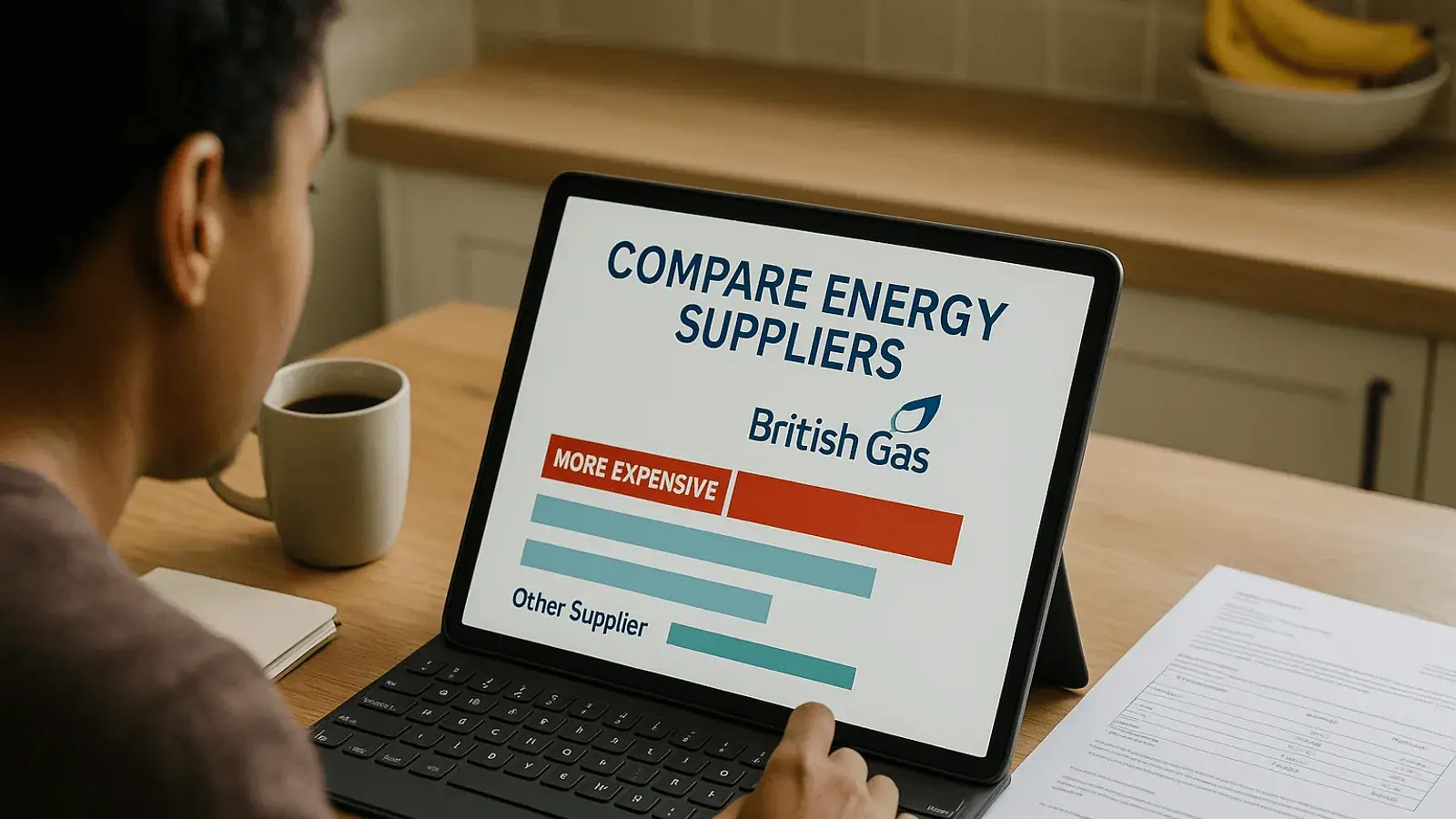
British Gas is one of the UK's largest energy suppliers, but staying on its default standard variable tariff is currently one of the most expensive ways to pay for your gas and electricity. Following a 13% rise in the Ofgem price cap on 1 July 2026, household energy bills have jumped again, driven b
Read guide →
Octopus Energy Refer a Friend Code – 2026
Octopus Energy runs one of the most popular refer-a-friend schemes in the UK energy market. While many suppliers stopped offering sign-up bonuses during the recent energy crisis, Octopus kept its scheme open. If you use a referral link from an existing customer to switch your gas or electricity, you
Read guide →
Cheap Energy Club vs Comparison Websites (Review)
Finding the cheapest energy deal used to be a yearly routine for many UK households. During the height of the energy crisis, competitive tariffs vanished, and switching suppliers offered no real benefit. Now, the energy market has reopened. Suppliers are competing for customers again, and fixed tari
Read guide →
Written by
Rob Gibbs
Hi, I'm Rob, and I run Energy-Review.co.uk. I initially started this project in 2018 when I was looking to switch energy suppliers and found there wasn't a website that provided simple, data-backed reviews on all the suppliers available. Since then, I have spent a lot of time (too much, some may say!) looking at all publicly available data about each supplier and writing reviews using this information. These reviews are updated as regularly as possible, and any data is backed up by a source where necessary. I have also started writing guides on various energy-related topics, which hopefully you will find useful. If you find any issues, please use our contact form to let us know.