
What is collective energy switching?
Research published in February 2026 found that one in four households on standard tariffs had not switched supplier in more than three years.

What is collective energy switching?
Research published in February 2026 found that one in four households on standard tariffs had not switched supplier in more than three years. This leaves millions of people stuck on standard variable tariffs, which are usually the most expensive way to pay for gas and electricity. Consumer habit means many households overpay simply because they do not have the time to search for a better deal.[1]
Collective energy switching offers a different approach. Instead of searching the market for a tariff on your own, you join a massive group of consumers to increase your buying power. A third-party organiser, such as a local council or a comparison site, uses the sheer size of the group to negotiate an exclusive rate from energy suppliers. The suppliers bid in an auction, and the winner gets to offer their tariff to the group. It is a simple, low-effort way to cut your bills.
Collective switching is a hassle-free way to secure a competitive fixed deal, though you must wait for specific auction windows and it may not beat the open market for every household.
Use our referral link, and we'll both get £50 credit once your switch is complete.
Existing customer? Find out how you can benefit too. T&Cs apply (only one switching offer per household)
How the collective switching process works
Individual consumers have very little power to negotiate with massive energy companies. If you call a supplier and ask for a discount, they will almost certainly say no. Collective switching turns this around by using sheer numbers. When tens of thousands of households group together, they create a highly attractive prospect for energy companies.
Energy suppliers spend a huge amount of money on marketing to attract customers one by one. By winning a collective auction, a supplier can gain thousands of new customers in a single day. This drastically lowers their administration and marketing costs. Because it costs them less to acquire the group, they can afford to offer a cheaper, exclusive tariff that you cannot find on the open market.
Who organises these schemes?
Any organisation that can reach a large number of people can set up a collective energy switch. In practice, they are usually run by local councils, housing associations, national newspapers, or price comparison websites.
Comparison sites have huge user bases, which gives them immense bargaining power. In February 2026, MoneySuperMarket launched a major Super Switch event to help households manage high living costs, noting that roughly 49% of consumers had been rationing their energy use. Specialist companies like iChoosr also run schemes on behalf of local authorities. The Essex Energy Switch is a well-known example that gathers residents from across the county to secure better rates.
How much money could you save?
The amount of money you save depends entirely on your current energy tariff and how much gas and electricity you use. If you have not switched for several years, you are likely sitting on your supplier's standard variable tariff. This means your bills are dictated by the Ofgem price cap. On 1 July 2026, Ofgem set the energy price cap at £1,663 a year for a typical dual-fuel household paying by Direct Debit. While this cap stops suppliers from charging unfair prices, it is rarely the cheapest way to buy energy.
Collective auctions can beat the price cap, but this is not guaranteed. In a June 2026 auction organised by Switch Together, British Gas — one of the UK's largest suppliers — won with a fixed dual-fuel tariff of £1,425 a year based on typical usage. This exclusive rate sat roughly £216 below the £1,641 Ofgem price cap in force at the time.
Historical schemes show similar results. The Essex Energy Switch recently reported that households saved an average of £200 on their bills. Meanwhile, MoneySuperMarket estimates that customers moving to a fixed-rate deal through their platform could save up to £382. Fixing your tariff also gives you price security, which is valuable given the ongoing volatility in the wider energy market. For instance, while domestic bills are capped, UK businesses face doubling electricity costs in 2026 due to a 94% increase in network charges. Securing a fixed domestic rate shields you from similar unexpected shocks.
The benefits and trade-offs
Collective switching has grown in popularity because it takes the hard work out of finding a good deal, but it is not perfect for everyone. You need to weigh the benefits against the practical trade-offs before you wait for an auction.
| Pros | Cons |
|---|---|
| The third-party organiser handles the complex negotiations for you. | You must wait for the organiser's registration and auction window. |
| You gain access to exclusive tariffs unavailable to the general public. | The winning deal might not be the absolute cheapest for unusual meter setups. |
| Many winning tariffs include 100% zero-carbon electricity as standard. | You only have a short, strict time limit to accept or decline the final offer. |
One of the biggest draws is the lack of hassle. The organiser handles the switching process for you. You just have to supply your basic details and decide whether to accept the final offer. On top of this, many of the winning tariffs now include 100% zero-carbon electricity. This allows you to support renewable energy without paying the premium often charged by specialist green suppliers.
However, the timing restrictions can be frustrating. You cannot use a collective switch on any day of the year. Schemes run to organiser-specific registration and auction windows, which can vary through the year. If your current fixed tariff ends in August, you might have to spend two months on a more expensive standard variable rate before the next auction opens. The winning tariff is also designed to be highly competitive for the average user in the group. If you have very specific usage habits, you might find a slightly cheaper deal by searching the open market yourself.
Rules, protections, and government schemes
When you take part in a collective switch, you are protected by strict industry rules. Ofgem, the energy regulator for Great Britain, enforces guidelines to keep the process fair and transparent.
Under Ofgem's Standard Licence Condition 22B, collective switching tariffs must be exclusive to the group and time-limited. This stops suppliers from offering the same deal to the general public, ensuring the collective genuinely gets a unique rate. A price comparison website accredited under Ofgem's voluntary Confidence Code must provide clear, accurate and unbiased information.
Energy efficiency schemes can also help lower your bills independently of your tariff. For example, the Boiler Upgrade Scheme currently offers grants of £7,500 towards the cost and installation of air-source or ground-source heat pumps.
As well as this, the government scrapped the Energy Company Obligation (ECO) levy from consumer bills in April 2026. By moving these costs to general taxation, the change was designed to help ease the pressure on household energy costs across the board.
Is a collective switch right for your household?
While collective switching works well for the vast majority of homes, your personal circumstances will dictate whether it is the best route for you. If you are one of the 50% of households that have not switched in the last three years, joining a collective is highly likely to save you money compared to staying on a default tariff.
If you are struggling to pay your current bills, switching might not be an immediate option. Existing debt can block a transfer to a new supplier. However, Ofgem regulations state that your current supplier must work with you to agree on an affordable payment plan. You should resolve any debt issues before relying on a collective switch to lower your costs.
Joining a collective switch is a low-effort way to cut your energy bills, especially if you have not switched in years.
By grouping together with thousands of other households, you get access to exclusive rates without having to negotiate or search the market yourself. It is entirely free to register, and you can walk away if the final offer does not suit you.
The main drawback is the timing. Because auctions only happen a few times a year, you must time your switch carefully. If you need to change suppliers immediately, you are better off running a standard comparison search.
Frequently asked questions
Am I obligated to switch if I register?
No. Registration is completely free and usually takes only a few minutes. When the auction ends and you receive your personal offer, there is zero obligation to accept it. You can simply walk away if the deal does not suit you.
Can I join a collective switch if I have a prepayment meter?
Yes. Most collective switching schemes cater to pay-as-you-go and prepayment customers. If you register with a prepayment meter, the winning supplier will offer a specific tariff tailored to your meter type.
Will the Ofgem price cap limit my maximum bill?
The price cap limits the unit rate and the daily standing charge, not your total bill. The widely reported figure of £1,663 for July 2026 is just an average. If you use more energy than a typical household, you will pay more than this amount.
Can I switch if I owe money to my current supplier?
You can register for a switch, but existing debt can prevent the transfer from going through. If you are in debt, you should speak to your supplier or an energy advice line. Ofgem rules mean your supplier must work with you to set up an affordable payment plan.
Do I lose my Warm Home Discount if I switch?
Eligibility depends on your circumstances and on being supplied by a participating supplier on the scheme's qualifying date, so check the supplier before switching. While most large suppliers offer the £150 discount, some smaller companies do not. You should verify this before you accept your personal offer.
Sources
Related reviews and comparisons

British Gas Review
British Gas is part of the Centrica group, and its brand history stretches back more than 200 years. Today, its household business combines energy supply with home services. That background helps explain its approach: it deals with both the energy homes use and the wider task of keeping them warm.
Read review →British Gas vs Outfox Energy
British Gas is owned by Centrica and is one of the UK's oldest and largest domestic energy suppliers. It offers a wide range of energy tariffs alongside home services like boiler cover, heating repairs, and Hive smart home devices. A key feature is its PeakSave scheme, which gives customers with sma
Read comparison →British Gas vs Tulo Energy
British Gas is owned by Centrica and is one of the UK's oldest and one of the biggest domestic energy suppliers. It supplies gas and electricity to homes across the country. What sets it apart is its wide range of extra home services, allowing customers to manage their energy supply and smart home t
Read comparison →E.ON Next vs Scottish Power
E.ON Next is the retail brand of the German energy group E.ON in the UK. It was set up to take on domestic customers after E.ON bought npower, making it one of the UK's largest suppliers. In May 2026, E.ON announced a planned deal to buy OVO Energy, which would increase its scale in the UK market. I
Read comparison →
100Green Review
100Green was founded in 2001 by Doug Stewart, originally as Green Energy Ltd. Stewart is now its Executive Chairman, and the company remains privately owned. Its background is in renewable energy, with an approach built around sustainability, fairness and clear dealings with customers.
Read review →Related guides

What Gas and Electricity discounts are available for the disabled?
Managing energy bills is a major challenge for many households. For people living with a disability or a chronic medical condition, the costs are often much higher. Running medical equipment, keeping the heating on for longer, and spending more time at home all push up energy use. The disability equ
Read guide →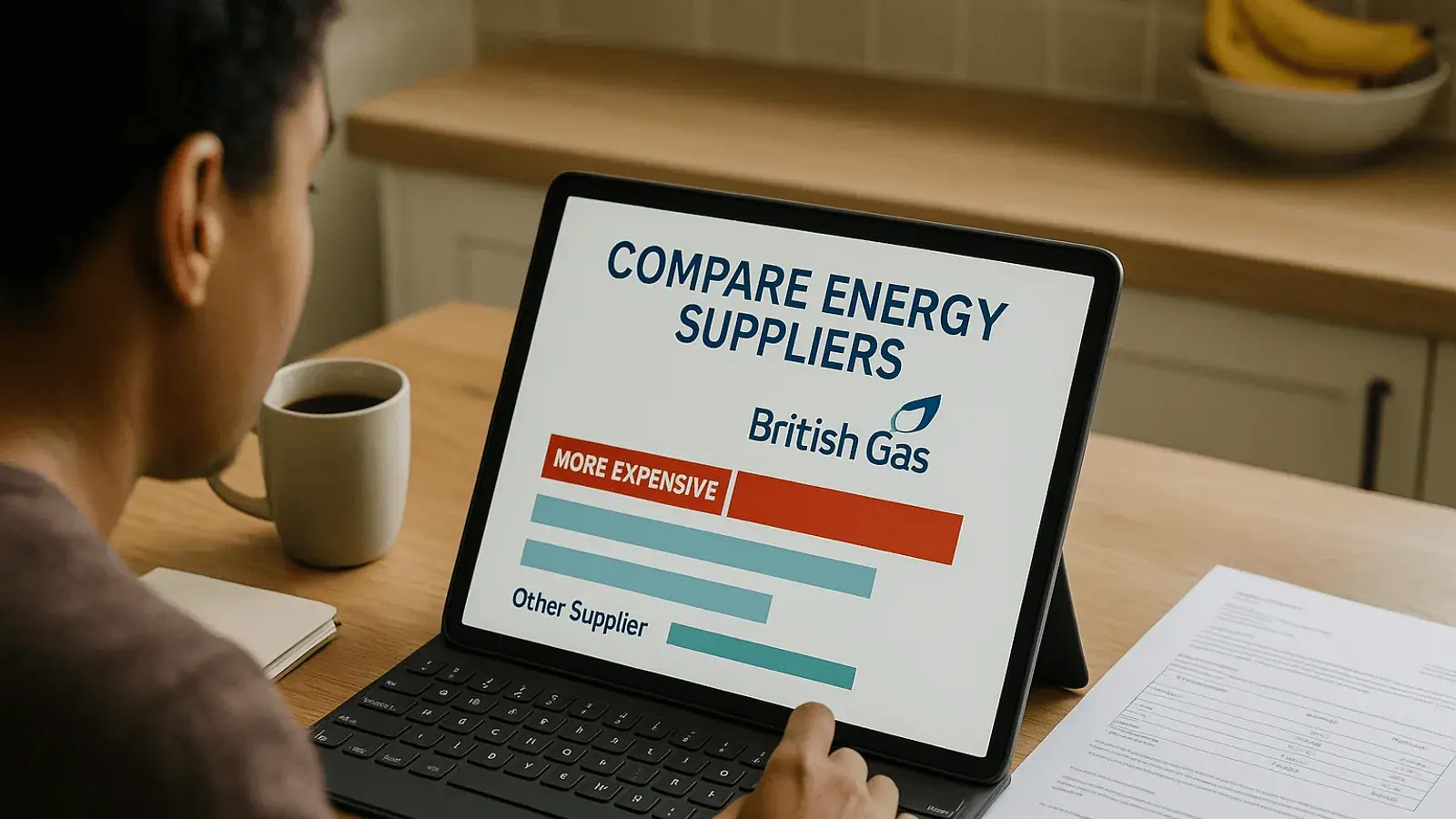
Who is cheaper than British Gas? (2026)
British Gas is one of the UK's largest energy suppliers, but staying on its default standard variable tariff is currently one of the most expensive ways to pay for your gas and electricity. Following a 13% rise in the Ofgem price cap on 1 July 2026, household energy bills have jumped again, driven b
Read guide →
Average Gas and Electricity Bill for a Four Bed House (2026)
Running a four-bedroom house comes with higher living costs, and energy bills usually make up a large part of the household budget. Because larger homes have more rooms to heat and often house more people, they naturally draw more power from the grid. For comparison purposes, this guide uses Ofgem's
Read guide →
Written by
Rob Gibbs
Hi, I'm Rob, and I run Energy-Review.co.uk. I initially started this project in 2018 when I was looking to switch energy suppliers and found there wasn't a website that provided simple, data-backed reviews on all the suppliers available. Since then, I have spent a lot of time (too much, some may say!) looking at all publicly available data about each supplier and writing reviews using this information. These reviews are updated as regularly as possible, and any data is backed up by a source where necessary. I have also started writing guides on various energy-related topics, which hopefully you will find useful. If you find any issues, please use our contact form to let us know.