
Who are the ‘Big Six’ energy suppliers?
For years, the term 'Big Six' was used to describe a specific group of energy companies that dominated the UK market.
Contents
- 1.What does the term 'Big Six' mean?
- 2.Who are the largest energy suppliers today?
- 3.How the UK energy market evolved
- 4.Recent mergers and industry shifts
- 5.Standard variable tariffs and the price cap
- 6.Should you choose a fixed or variable tariff?
- 7.What happens if a large supplier goes bust?
- 8.How to compare and choose a supplier
- 9.FAQs
What does the term 'Big Six' mean?
For years, the term 'Big Six' was used to describe a specific group of energy companies that dominated the UK market. These companies emerged after the energy sector was privatised in the 1990s. Today, the phrase is mostly an outdated industry label. The original line-up no longer exists, as several older brands have closed down and newer businesses have taken their place at the top.
Instead of a fixed group of six, it is more accurate to look at the largest domestic suppliers operating in Great Britain today. Following the wholesale gas crisis in 2021 and 2022, dozens of smaller challenger suppliers went out of business. This left the remaining large companies with an even tighter hold on the market. Right now, the top six suppliers provide gas and electricity to around 91% to 92% of households.
Use our referral link, and we'll both get £50 credit once your switch is complete.
Existing customer? Find out how you can benefit too. T&Cs apply (only one switching offer per household)
Who are the largest energy suppliers today?
The list of the largest energy suppliers has shifted significantly over the last few years. As of mid-2026, the market is led by a mix of long-established companies and newer brands that have grown rapidly.
Octopus Energy is the UK's largest domestic energy supplier. Founded in 2015, it passed 8 million UK customers in April 2026. It holds a 25.7% share of the electricity market, having officially overtaken British Gas for electricity supply in late 2023 and early 2024. The company consistently scores highly in customer satisfaction surveys, often reaching around 90%.
British Gas, owned by Centrica, is one of the UK's oldest and most recognised suppliers. It is one of the UK's largest domestic energy suppliers. It supplies around 10 million homes. E.ON Next, owned by a German parent company, supplies around 5.6 million customers. It holds 15.3% of the electricity market and 13% for gas, having grown partly by absorbing Npower's customers in 2021.
OVO Energy supplies around 4 million customers. It holds 11.7% of the electricity market and 9.8% for gas. It expanded massively by taking on all of SSE's domestic customers by 2023. EDF Energy is a French state-owned company that holds roughly 9.7% of the electricity market and 8.2% for gas. Finally, ScottishPower is owned by the Spanish firm Iberdrola. It holds around 7.9% of the electricity market and 7% for gas.
| Supplier | Electricity market share | Gas market share |
|---|---|---|
| Octopus Energy | ~25.7% | Data varies by quarter |
| British Gas | ~20.4% | ~26.7% |
| E.ON Next | ~15.3% | ~13.0% |
| OVO Energy | ~11.7% | ~9.8% |
| EDF Energy | ~9.7% | ~8.2% |
| ScottishPower | ~7.9% | ~7.0% |
How the UK energy market evolved
The Gas Act 1986 privatised British Gas, while the Electricity Act 1989 provided the framework to restructure and privatise the electricity supply industry in Great Britain. The six suppliers later known as the UK's largest suppliers were British Gas, EDF Energy, E.ON, npower, ScottishPower and SSE. Until the early 2000s, almost all homes bought their gas and electricity from these specific companies.
Over time, ownership and branding changed. PowerGen was bought by a German owner and became E.ON. Innogy was bought and renamed Npower. By the 2010s, smaller challenger suppliers started to enter the market, offering cheaper deals or focusing entirely on green energy. At one point, these smaller suppliers held around 28% of all energy customers, forcing the larger companies to innovate.
This trend reversed sharply during the wholesale gas crisis in 2021 and 2022. As the cost of buying energy soared, over 30 smaller suppliers could not afford to stay in business and collapsed. Millions of customers were moved back to the largest suppliers through regulator safety nets. Older brands also disappeared from the domestic market entirely. Npower's domestic business was absorbed by E.ON Next, and SSE's retail arm was taken over by OVO. This series of events left the current top companies with firm control of the market once again.
Recent mergers and industry shifts
The energy market is still changing rapidly. In May 2026, E.ON agreed to buy OVO Energy's retail business. This planned merger is currently waiting for approval from the Competition and Markets Authority (CMA) in the second half of 2026. If the deal goes ahead, the combined company will supply around 9.6 million households. This would create a new giant in the market, potentially challenging Octopus Energy for the top spot.
Suppliers are also changing how they interact with their customers. In July 2026, Centrica announced plans to cut around 1,300 jobs over two years, including around 500 customer-operations roles. The company stated this is due to a massive shift in customer habits, noting that around 90% of its customers now prefer to use digital channels and artificial intelligence chatbots rather than making a phone call.
Standard variable tariffs and the price cap
Most people who get their energy from the largest suppliers are on a standard variable tariff. In Great Britain, these default tariffs are controlled by the Ofgem price cap. The regulator reviews the cap every three months, in January, April, July, and October. It sets a maximum limit on the daily standing charges and the per-unit rates that suppliers can charge you.
For the period from 1 July to 30 September 2026, the price cap is set at £1,663 a year for a typical dual-fuel household paying by Direct Debit. This represents a 13% increase from the previous cap in April 2026. In July 2026, Ofgem also introduced new Typical Domestic Consumption Values. These figures estimate how much gas and electricity an average home uses, helping the regulator set the cap at a realistic level.
Because the price cap limits what suppliers can charge on their standard tariffs, the default rates offered by the biggest companies are often very similar. Rates can differ by payment method, so compare the tariff available for your meter and how you pay. The table below gives illustrative standard variable tariff rates. Your actual rates depend on your region, payment method and meter type.
| Supplier | Electricity unit rate | Gas unit rate | Exit fee |
|---|---|---|---|
| EDF Energy Standard (Variable) | 25.09p per kWh | 7.18p per kWh | None |
| British Gas Standard Variable | 25.09p per kWh | 7.18p per kWh | None |
| ScottishPower Standard | 25.09p per kWh | 7.18p per kWh | None |
Should you choose a fixed or variable tariff?
With the July 2026 price cap rising by 13%, many households face a choice between staying on a standard variable tariff or switching to a fixed-rate deal. A fixed tariff locks in your unit rates and standing charges for a set time, usually one or two years. This protects you if the price cap goes up again in the future.
The trade-off is that you might miss out on savings if wholesale energy prices drop and the Ofgem price cap falls. Fixed tariffs also usually come with exit fees if you decide to leave the contract early. For example, the British Gas Fix and Fall July 2028 tariff carries a £150 exit fee per fuel, while the EDF Simply Fixed July 2027 tariff charges £100 per fuel. If you change your mind halfway through the term, it can be expensive to switch away.
What happens if a large supplier goes bust?
Even large energy companies can face financial difficulties. If your supplier goes out of business, you will not lose your gas or electricity supply. Ofgem runs a safety net called the Supplier of Last Resort scheme. Under this system, the regulator automatically moves your account to a new supplier. Your energy supply stays on the whole time.
Any credit balance you have built up on your account is protected and will transfer to your new supplier. If this happens, you should take a meter reading and wait for the new company to contact you before trying to switch anywhere else. Following the market crash in 2021 and 2022, Ofgem also introduced strict financial resilience rules. All energy suppliers must now hold minimum capital buffers to handle market shocks, ensuring they do not rely entirely on customer credit balances to fund their operations.
How to compare and choose a supplier
Because standard variable rates are heavily restricted by the price cap, price is no longer the only factor to consider when choosing between the largest suppliers. You should also look at how they treat their customers and what types of tariffs they offer.
Frequently asked questions
Are the largest UK energy suppliers all British-owned?
No, several of the largest suppliers have foreign ownership. EDF Energy is French state-owned, ScottishPower is owned by the Spanish firm Iberdrola, and E.ON is owned by a German parent company.
Do Npower and SSE still supply energy to homes?
No, neither brand exists as a domestic energy supplier today. Npower's domestic customers were absorbed by E.ON Next in 2021, and SSE's retail arm was migrated entirely to OVO Energy by 2023.
Will I lose my money if my energy supplier goes bust?
No. Under Ofgem's Supplier of Last Resort scheme, your energy supply will remain uninterrupted. Any outstanding credit balance on your account is fully protected and will be transferred to your new supplier.
Do all the big suppliers charge the same prices?
Their standard variable tariffs are very similar because they are all limited by the Ofgem price cap. However, the rates and exit fees on their fixed tariffs can vary significantly between companies.
Is it always cheaper to pay by Direct Debit?
Rates can differ by payment method, so you should compare the tariff available for your meter and how you pay. Suppliers factor the costs of different payment methods into their pricing.
Related reviews and comparisons
EDF Energy vs OVO Energy
EDF Energy was formed in 2002 and is the UK retail branch of the French state-owned EDF Group. It is a long-established and widely recognised energy brand, as well as one of the UK's largest domestic energy suppliers. The company is heavily involved in UK nuclear power generation and is leading larg
Read comparison →
E.ON Next Review
E.ON Next is the home energy brand of the wider E.ON group. It was set up to replace the older E.ON brand and npower after E.ON bought the company. Today, it is one of the UK's biggest domestic energy suppliers.
Read review →
Outfox Energy Review
Outfox Energy is an independent UK energy supplier based in Leicester. It was set up in 2017 under the name Outfox the Market and is owned by Foxglove Energy Supply Limited. Operating as a family-run business, it is one of the UK's smaller domestic energy suppliers.
Read review →Good Energy vs OVO Energy
Founded in 1999, Good Energy is one of the UK's oldest green energy suppliers. It is a renewable energy supplier that focuses on renewable power and green technology. It has recently bought several solar and heat pump installation firms to grow its home services business.
Read comparison →EDF Energy vs Outfox Energy
EDF Energy was formed in 2002 and is owned by the French state-owned EDF Group. It is one of the UK's largest domestic energy suppliers. The company generates its own electricity and leads large infrastructure projects, such as building the Hinkley Point C nuclear power station. It offers standard a
Read comparison →Related guides
Who is cheaper than British Gas? (2026)
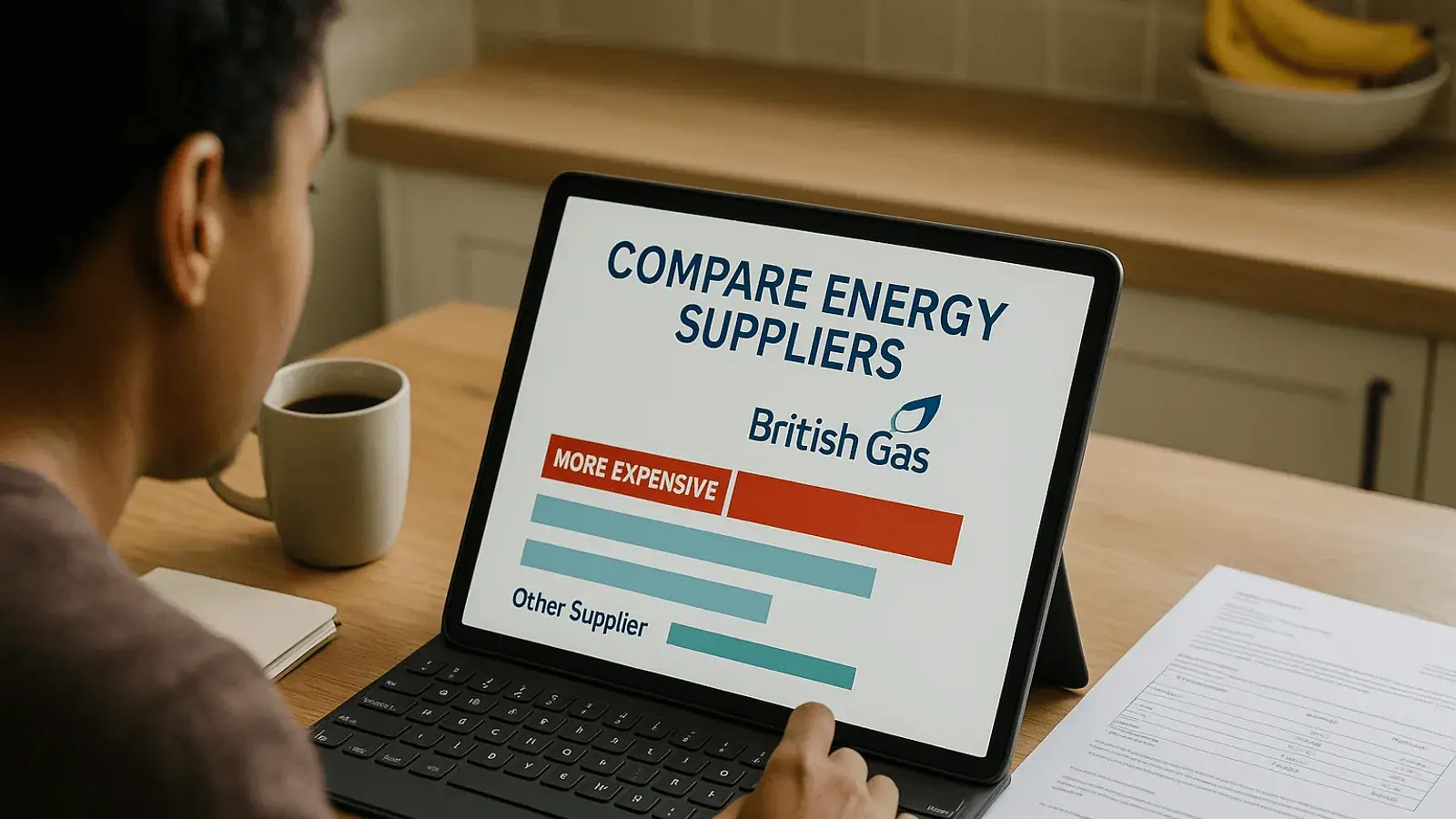
British Gas is one of the UK's largest energy suppliers, but staying on its default standard variable tariff is currently one of the most expensive ways to pay for your gas and electricity. Following a 13% rise in the Ofgem price cap on 1 July 2026, household energy bills have jumped again, driven b
Read guide →
Which energy suppliers are going bust?
The UK energy market has seen massive upheaval over the past few years. During the peak of the energy crisis in 2021 and 2022, wholesale costs soared and caused dozens of suppliers to collapse. By July 2026, the market has largely stabilised. However, smaller companies still occasionally fail, and t
Read guide →
Octopus Energy Refer a Friend Code – 2026
Octopus Energy runs one of the most popular refer-a-friend schemes in the UK energy market. While many suppliers stopped offering sign-up bonuses during the recent energy crisis, Octopus kept its scheme open. If you use a referral link from an existing customer to switch your gas or electricity, you
Read guide →
Written by
Rob Gibbs
Hi, I'm Rob, and I run Energy-Review.co.uk. I initially started this project in 2018 when I was looking to switch energy suppliers and found there wasn't a website that provided simple, data-backed reviews on all the suppliers available. Since then, I have spent a lot of time (too much, some may say!) looking at all publicly available data about each supplier and writing reviews using this information. These reviews are updated as regularly as possible, and any data is backed up by a source where necessary. I have also started writing guides on various energy-related topics, which hopefully you will find useful. If you find any issues, please use our contact form to let us know.