
Which energy suppliers are going bust?
The UK energy market has seen massive upheaval over the past few years.

Contents
- 1.The 2026 energy market landscape
- 2.What happens if your energy supplier goes bust?
- 3.Practical steps to take if your supplier fails
- 4.Why did so many energy suppliers fail?
- 5.Recent supplier exits and market consolidation
- 6.List of energy suppliers that have ceased trading
- 7.Financial rules and Ofgem protections
- 8.Current energy costs and government support
- 9.Fixed versus variable tariffs in 2026
- 10.FAQs
The 2026 energy market landscape
The UK energy market has seen massive upheaval over the past few years. During the peak of the energy crisis in 2021 and 2022, wholesale costs soared and caused dozens of suppliers to collapse. By July 2026, the market has largely stabilised. However, smaller companies still occasionally fail, and the landscape looks very different today than it did a few years ago.
Following the collapse of over 30 suppliers, the market is now dominated by larger, consolidated firms. Octopus Energy has seen massive growth, taking over Bulb in 2022 and Shell Energy in late 2023, which has made it the UK's largest supplier. Meanwhile, well-known names like British Gas, E.ON Next, and EDF Energy have absorbed hundreds of thousands of customers from smaller failed brands.
While the wave of mass bankruptcies is behind us, isolated failures still occur. For example, Tomato Energy ceased trading in November 2025. If you are worried about your current supplier, it helps to understand exactly what happens when an energy company fails and the steps you should take to protect your money.
Use our referral link, and we'll both get £50 credit once your switch is complete.
Existing customer? Find out how you can benefit too. T&Cs apply (only one switching offer per household)
What happens if your energy supplier goes bust?
The most common fear when an energy company fails is that the gas and electricity will be cut off. This is a misconception. Supply is never interrupted. The energy regulator, Ofgem, has a safety net in place called the Supplier of Last Resort process. This system is designed to protect consumers and ensure the lights stay on.
When a supplier announces it has ceased trading, Ofgem immediately steps in. The regulator runs a rapid competitive process to appoint a new supplier for all the affected customers. Ofgem chooses the new supplier based on their ability to handle the extra accounts and their commitment to protecting customer credit balances. A recent example is British Gas being appointed to take on Tomato Energy customers in November 2025.
Your credit balance is fully protected under these rules. If your account is in credit when your old supplier fails, the newly appointed supplier will honour that balance and apply it to your new account. You will not lose the money you have paid in advance.
If you are in debt to your old supplier, that debt does not disappear. You will still need to pay it off. Depending on the arrangement Ofgem makes, you will either owe the money to the new supplier or to the administrators handling the failed company's closure. You will be contacted with clear instructions on how to clear the balance.
Practical steps to take if your supplier fails
When news breaks that your supplier has gone bust, it is easy to panic. However, the best approach is to stay calm and follow a few simple steps to ensure your account transfers smoothly.
Why did so many energy suppliers fail?
The string of supplier collapses in 2021 and 2022 was driven by a combination of global wholesale price spikes and vulnerable business models. Energy suppliers buy the gas and electricity they need to supply homes on the wholesale market months in advance. This is known as hedging.
Many smaller suppliers that entered the market before 2021 did not buy enough energy in advance. When global wholesale prices skyrocketed, these companies were forced to buy energy at record high costs just to keep their customers supplied. Because the Ofgem price cap limits how much suppliers can charge households on standard variable tariffs, these companies had to sell the energy for much less than they bought it for.
Operating at a massive loss quickly drained their cash reserves, forcing them into administration. Larger suppliers with stronger financial backing and better hedging strategies were able to absorb the wholesale price shocks, which is why the market is now dominated by a smaller number of large, consolidated firms.
Recent supplier exits and market consolidation
While the chaotic market conditions of 2021 have passed, the UK energy sector continues to see significant consolidation. Several well-known brands have either ceased trading, been bought out, or restructured their businesses between 2023 and 2026.
Octopus Energy has driven much of this consolidation. After taking over Bulb in 2022, Octopus acquired Shell Energy Retail in December 2023. By March 2024, all 1.3 million Shell home energy customers were successfully migrated to Octopus, and the Shell Energy brand disappeared from the UK domestic market. Because of these acquisitions and its own growth, Octopus Energy is now the UK's largest energy supplier.
Other suppliers have chosen to restructure rather than exit entirely. In late 2025, Utilita agreed to sell approximately 40,000 of its credit customers to EDF Energy. This transfer took effect in November 2025, allowing Utilita to focus entirely on its core Smart Pay As You Go market.
Corporate takeovers have also reshaped the market. In April 2025, Good Energy was bought for £99.4 million by Esyasoft, a Dubai-based company. Following the takeover, Good Energy was delisted from the stock market, though it continues to operate under its original brand and maintain its renewable energy model.
Outright failures are now rare but not impossible. Tomato Energy ceased trading in November 2025, with Ofgem appointing British Gas to take on its customer base. Rebel Energy also collapsed in 2025, which subsequently caused its partner brand, Ebico Living, to cease operations in April 2025.
List of energy suppliers that have ceased trading
If you were a customer of one of the many suppliers that failed during the energy crisis, your account was automatically moved to a larger provider. In some cases, the company that originally took on your account has since been bought by another supplier.
For example, Ofgem originally moved customers of GOTO Energy, Daligas, Pure Planet, and Green. to Shell Energy in 2021. Because Octopus Energy bought Shell in late 2023, all those households are now Octopus customers. The table below shows the most notable supplier failures since 2021 and where those accounts ended up.
| Failed supplier | Date collapsed | Current supplier |
|---|---|---|
| Tomato Energy | June 2026 | British Gas |
| Together Energy | January 2022 | British Gas |
| Zog Energy | December 2021 | EDF Energy |
| Orbit Energy | November 2021 | ScottishPower |
| Entice Energy | November 2021 | ScottishPower |
| Bulb | November 2021 | Octopus Energy |
| Neon Reef | November 2021 | British Gas |
| Omni Energy | November 2021 | Utilita |
| Zebra Power | November 2021 | British Gas |
| Ampower | November 2021 | Yü Energy |
| Bluegreen Energy | November 2021 | British Gas |
| GOTO Energy | October 2021 | Octopus Energy |
| Daligas | October 2021 | Octopus Energy |
| Pure Planet | October 2021 | Octopus Energy |
| Igloo Energy | September 2021 | E.ON Next |
| Symbio Energy | September 2021 | E.ON Next |
| Enstroga | September 2021 | E.ON Next |
| Avro Energy | September 2021 | Octopus Energy |
| Green. | September 2021 | Octopus Energy |
Financial rules and Ofgem protections
To prevent a repeat of the 2021 crisis, Ofgem has introduced much stricter regulations for anyone wanting to supply energy in the UK. The regulator now stress-tests suppliers regularly to ensure their business models can withstand sudden shocks in the global wholesale market.
The most significant change is the implementation of strict capital target rules, which took full effect in March 2025. These rules force energy suppliers to hold a minimum amount of capital in reserve. This financial cushion ensures that if wholesale prices suddenly spike, the supplier has enough money to buy energy without going bankrupt.
By forcing suppliers to prove their financial resilience, Ofgem aims to weed out poorly run companies before they fail. While this makes it harder for new, small suppliers to enter the market, it provides much greater stability for households.
Current energy costs and government support
Even with a more stable market, household energy costs remain high compared to pre-2021 levels. For 1 July to 30 September 2026, Ofgem's price cap for a typical dual-fuel household paying by Direct Debit is £1,663 a year. The exact amount you pay depends on how much energy you use, where you live, and how you pay your bills.[1]
To help with the ongoing cost of living, new government support measures have been introduced. In July 2026, Prime Minister Andy Burnham announced that VAT on domestic electricity bills will be cut from 5% to 0% from 1 October 2026. The measure is funded for the 2026/27 financial year, while any longer-term action will be decided at the Budget. Northern Ireland is due to receive comparable support rather than the VAT change itself.
Targeted support also continues for those most in need. The Warm Home Discount scheme will reopen in Autumn 2026, providing a one-off rebate to eligible low-income households to help cover winter heating costs. If you are struggling to pay your bills, you should contact your supplier directly to discuss payment plans or check if you qualify for extra help.
Fixed versus variable tariffs in 2026
If you are with a stable supplier, you may be wondering whether to stick with the default variable tariff or lock into a fixed deal. Fixed tariffs have returned to the market in 2026, giving households the option to secure a set price for their energy for 12 or 24 months.
The trade-off is between price certainty and flexibility. If you stay on a standard variable tariff, your rates are governed by the Ofgem price cap. This means your bills will fall if wholesale prices drop, but they will also rise if the market spikes. A fixed tariff protects you from price increases, but you will not benefit if the price cap falls during your contract.
If you decide to fix, you should be aware of exit fees. Most suppliers charge a penalty if you want to leave a fixed contract early. For example, the Octopus 12M Fixed tariff carries a £50 exit fee per fuel, while the EDF Energy Simply Fixed 2Yr tariff and the Utility Warehouse Fixed Saver 90 both charge £150 per fuel. E.ON Next charges £100 per fuel on its 24-month fix. Always check the terms carefully before signing up.
Frequently asked questions
Will my gas and electricity be cut off if my supplier goes bust?
No. Supply is never interrupted. Ofgem's Supplier of Last Resort process ensures that your gas and electricity continue to flow while your account is moved to a new provider.
Do I lose my credit balance when an energy company fails?
No. Your credit balance is fully protected by Ofgem. The newly appointed supplier will honour any money you had in your account and apply it to your new bills.
Should I cancel my Direct Debit if my supplier stops trading?
No. You should leave your Direct Debit active. Keeping it open means you can continue to be billed for the energy you use while the transfer is completed.
Sources
Am I forced to stay with the new supplier Ofgem chooses?
No. Once your new account is fully set up and your credit balance has been transferred, you are free to switch to any other supplier. You will not be charged any exit fees for leaving the new default tariff.
What happens if I am in debt to the failed supplier?
You still owe the money. Depending on the arrangement made by Ofgem, you will either need to pay the debt to the new supplier or to the administrators handling the failed company. You will receive clear instructions on how to clear the balance.
Related reviews and comparisons
EDF Energy vs Good Energy
EDF Energy was formed in 2002 and is the UK retail branch of the French state-owned energy company, Électricité de France. It is one of the UK's largest domestic energy suppliers. The company supplies gas and electricity, and installs solar panels, batteries, and electric vehicle chargers. What sets
Read comparison →Best No-Exit-Fee Energy Suppliers in the UK
16 suppliers had qualifying evidence for September 2026. Suppliers are ordered using each supplier’s cheapest tariff with a £0 exit fee. The ranking is price-based: Home Energy had the lowest qualifying annual cost at £1,453.
Read article →
Outfox Energy Review
Outfox Energy is an independent UK energy supplier based in Leicester. It was set up in 2017 under the name Outfox the Market and is owned by Foxglove Energy Supply Limited. Operating as a family-run business, it is one of the UK's smaller domestic energy suppliers.
Read review →
Cheapest Energy Suppliers in the UK
63 tariffs from 16 suppliers met the common September 2026 filters. Home Energy’s Fair Variable Dual ranked first at £1,453 a year (£121 a month). Prices are estimates for the stated usage, region and payment method, not personalised quotes.
Read article →
Cheapest Fixed Energy Tariffs in the UK
36 tariffs from 14 suppliers met the common September 2026 filters. Fuse Energy’s August 2026 Fixed (18m) V15 ranked first at £1,489 a year (£124 a month). Prices are estimates for the stated usage, region and payment method, not personalised quotes.
Read article →Related guides
Who are the ‘Big Six’ energy suppliers?
For years, the term 'Big Six' was used to describe a specific group of energy companies that dominated the UK market. These companies emerged after the energy sector was privatised in the 1990s. Today, the phrase is mostly an outdated industry label. The original line-up no longer exists, as several
Read guide →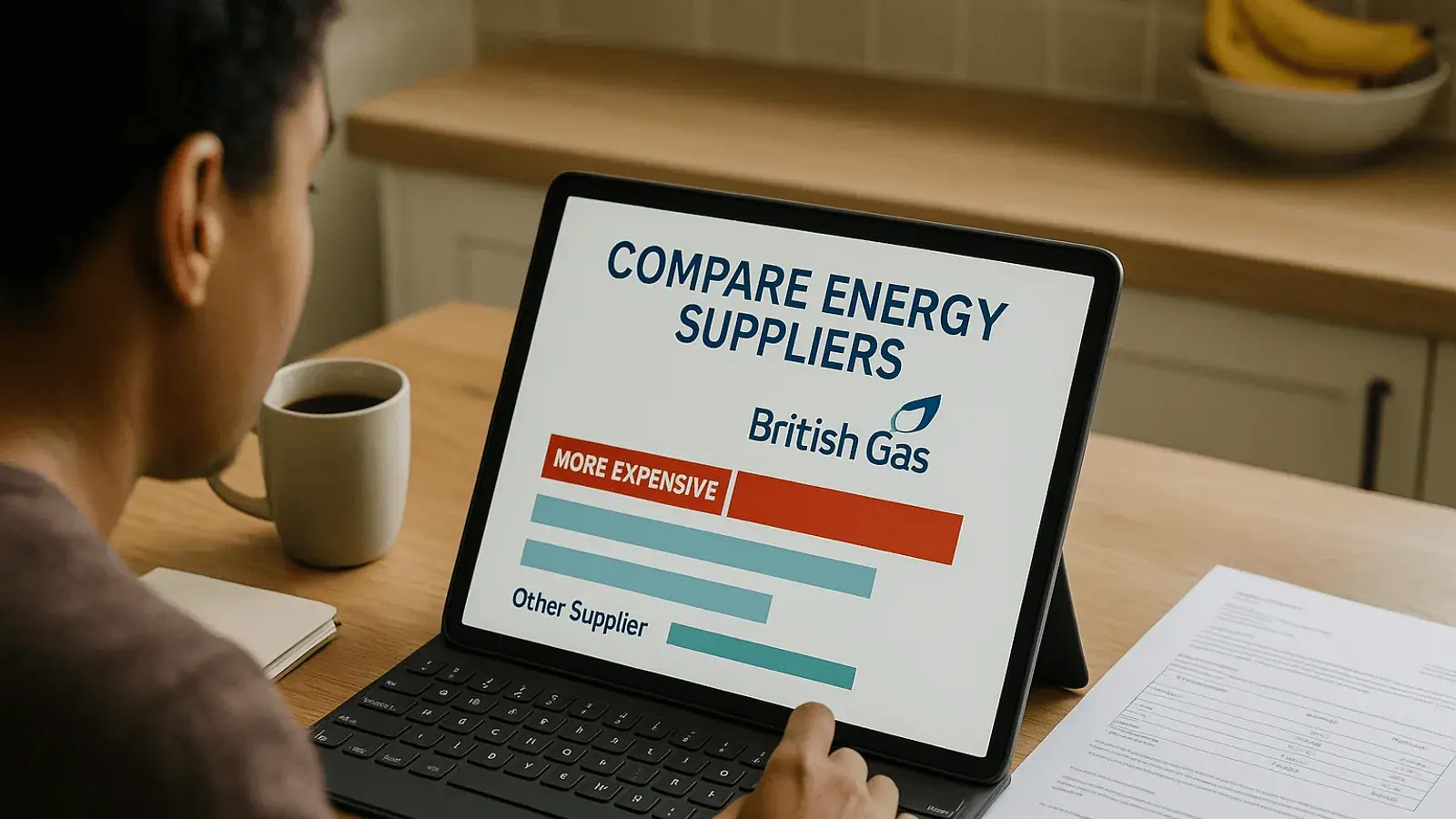
Who is cheaper than British Gas? (2026)
British Gas is one of the UK's largest energy suppliers, but staying on its default standard variable tariff is currently one of the most expensive ways to pay for your gas and electricity. Following a 13% rise in the Ofgem price cap on 1 July 2026, household energy bills have jumped again, driven b
Read guide →
What is collective energy switching?
Research published in February 2026 found that one in four households on standard tariffs had not switched supplier in more than three years. This leaves millions of people stuck on standard variable tariffs, which are usually the most expensive way to pay for gas and electricity. Consumer habit mea
Read guide →
Written by
Rob Gibbs
Hi, I'm Rob, and I run Energy-Review.co.uk. I initially started this project in 2018 when I was looking to switch energy suppliers and found there wasn't a website that provided simple, data-backed reviews on all the suppliers available. Since then, I have spent a lot of time (too much, some may say!) looking at all publicly available data about each supplier and writing reviews using this information. These reviews are updated as regularly as possible, and any data is backed up by a source where necessary. I have also started writing guides on various energy-related topics, which hopefully you will find useful. If you find any issues, please use our contact form to let us know.