
Moving Home Energy Checklist
Moving home triggers an automatic switch to a deemed energy contract, but you can change supplier immediately without paying exit fees.
Contents
Sorting your energy when moving home
Moving to a new house involves a long list of tasks, and setting up your gas and electricity is easy to overlook. However, sorting out your energy early helps you avoid paying for power you did not use. It also stops you from falling onto an expensive tariff by default.
Moving home means closing the account at your old address and opening one at the new property. You may be able to keep your current tariff if your supplier agrees. Otherwise, the property will already have an energy supplier and, once you are responsible for it, you will normally be placed on its default tariff until you choose a deal.[1]
This guide explains exactly what you need to do before, during, and after your move. It covers how to handle final bills, what to do with your Direct Debit, and how to switch to a better deal once you have settled in. At the end of the guide, you will find a printable checklist to help you keep track of each step.
Use our referral link, and we'll both get £50 credit once your switch is complete.
Existing customer? Find out how you can benefit too. T&Cs apply (only one switching offer per household)
Preparation: Before you move out
The process of closing your old energy account starts before moving day. You need to give your current gas and electricity supplier enough notice so they can prepare your final bill. Citizens Advice recommends contacting your supplier at least 48 hours before you move out.
Give the supplier your exact moving date and a forwarding address. Without current contact details, final bills and credit refunds can be delayed. In October 2025, Ofgem and Energy UK said there was more than £240 million in closed energy accounts, with missing customer details delaying refunds.[1]
Do not cancel your Direct Debit yet
Many people cancel their energy Direct Debit a few days before they move because they want to prevent another payment. Cancelling it before the final account is settled can cause avoidable delays.
Keeping your Direct Debit active until the final bill is settled is usually the simplest option. It lets the supplier collect any amount you owe and may make a credit refund more straightforward. Make sure the supplier also has your current contact and bank details.
You should only cancel the Direct Debit at your bank after the final bill has been settled and any credit has been refunded to your account.
Find your supply numbers
Before you pack away your paperwork, find a recent energy bill and note down your supply numbers. These are the unique reference numbers for your home's connection to the energy network.
Your electricity number is called an MPAN (Meter Point Administration Number). It is 21 digits long and usually sits inside a grid containing a large letter 'S'. Your gas number is called an MPRN (Meter Point Reference Number) and is up to 10 digits long. Taking a photo of a recent bill that shows these numbers is a good idea. If there is any confusion about your address on the national database later, giving these numbers to your supplier will clear it up instantly.
Owing money to your supplier does not stop you moving home. For a supplier switch, debt outstanding for less than 28 days will normally be added to your final bill. Older debt can affect the switch, so contact your old supplier to arrange repayment.[2]
Move day: Leaving your old home
On the day you move out, your main job is to record exactly how much energy you have used up to the point you hand over the keys. This stops you from being charged for energy used by the new owners or tenants after you leave.
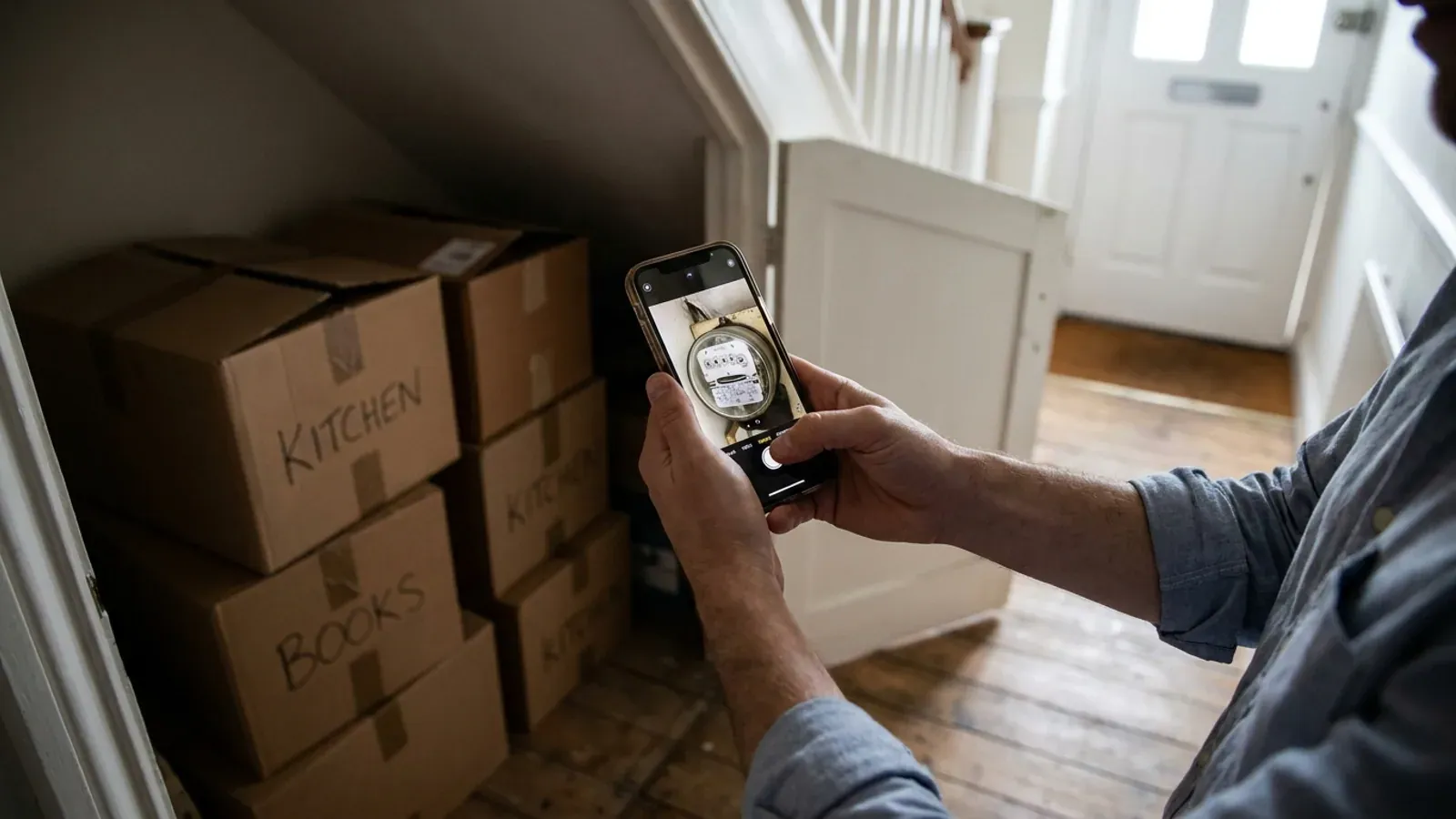
Read your gas and electricity meters just before you walk out the door. Write the numbers down and take a clear photograph of each meter screen. The photographs give you useful evidence of the readings if the supplier later uses a different estimate or the account is disputed.
You must take manual readings and photographs even if you have a smart meter. Smart meters are designed to send readings automatically, but they rely on a mobile network connection. If that connection drops out on moving day, the supplier will not get the final reading. Taking a photo takes a few seconds and acts as a reliable backup.
Final bills and automatic compensation
Once you have the readings, submit them to your supplier either by phone, through their app, or on their website. The supplier will then generate your final bill.
Energy suppliers must follow strict deadlines when you leave. Under Ofgem's Guaranteed Standards of Performance, your old supplier has a maximum of six weeks to send you your final bill. If they miss this deadline, they must automatically pay you £40 in compensation.
If your final bill shows that your account is in credit, the supplier then has 10 working days to refund that money to you. If they miss this second deadline, they owe you another £40. These compensation amounts increased to £40 in early 2025 to give suppliers a stronger reason to sort out final accounts quickly.
Move day: Arriving at your new home
Make energy one of the first jobs at your new property. Recording the opening position separates your usage from the previous occupant's account.
First, locate the gas and electricity meters. They might be in a hallway cupboard, under the stairs, or in an external meter box on the outside wall. If the meters are outside, you might need a meter box key to open them. These are cheap plastic keys you can buy from most hardware shops.
Just as you did when leaving your old home, take opening readings and clear, timestamped photographs of both meter screens. You will need to give these readings to the supplier currently providing energy to the property.
If the property has a smart meter, the in-home display should be left behind by the previous occupants. Plug it in and check whether it connects to the meters. If it continues to show the previous occupant's data or does not update after your account is set up, contact the supplier because it may need support or pairing.
Settling in: Setting up and switching
For the first few days in your new home, your energy will be supplied by whichever company the previous occupant used. You need to find out who this is so you can set up an account in your name.
If the previous owner or landlord did not tell you who the supplier is, you can find out easily. For electricity, use the search tool on the Energy Networks Association website. For gas, you can use the Find My Supplier website or call their automated phone line on 0870 608 1524. You will just need to provide your new postcode and address.
How deemed contracts work
Once you know who the supplier is, contact them and give them your opening meter readings. They will set up a new account in your name. Because you have not actively chosen a tariff yet, you will be placed on what is known as a 'deemed contract'.
A deemed contract is a legal safety net. It means you have a continuous supply of energy from the moment you move in, without having to sign any paperwork. Deemed contracts are protected by the Ofgem energy price cap. From 1 July to 30 September 2026, the cap is equivalent to £1,663 a year at Ofgem's typical consumption values for a Direct Debit household in Great Britain. Your actual bill depends on how much energy you use because the cap limits unit rates and standing charges, not the total bill.
Crucially, Ofgem rules state that deemed contracts cannot include any exit fees. You are not tied to this supplier, and you do not have to stay on this tariff.
Comparing and switching
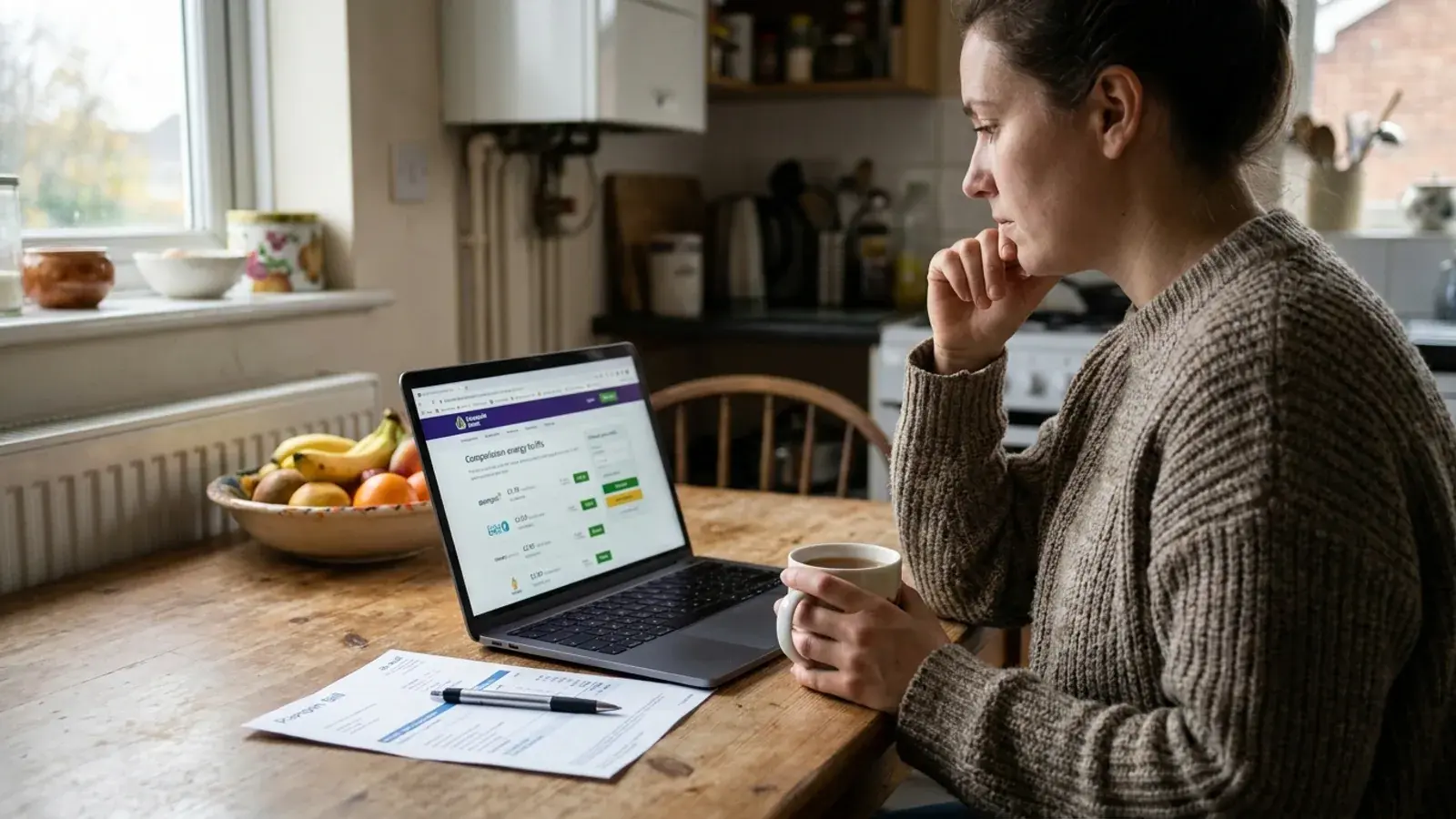
Because deemed contracts have no exit fees, you are completely free to run a price comparison and switch to a different supplier on your very first day in the property. You do not have to wait for a bill to arrive.
Use an energy comparison site to check the whole market. You might find a fixed tariff that offers better rates than the standard price cap. If you decide to switch, the new process is very fast. A standard energy switch now takes a maximum of five working days to complete.
The existing supplier will bill you for the few days of energy you used between moving in and the switch completing. You pay that small final bill, and then your new chosen supplier takes over.
Special circumstances: Renters, new builds, and Northern Ireland
The standard moving process applies to most people, but there are a few exceptions depending on your housing situation or where you live in the UK.
For renters, the right to switch energy supplier depends on who pays the bill. A tenant who pays the supplier directly can normally choose the supplier; where the landlord holds and pays the account, the tenant cannot switch it. You can read the practical details in our guide to switching energy supplier if you are a tenant.
A brand-new build or long-disconnected property needs a different process. Contact the local network operator to arrange the connection and choose an energy supplier to arrange meter installation at the same time. This can help avoid delays.[1]
Finally, if you are moving home in Northern Ireland, the rules are entirely different. Northern Ireland operates a separate energy market regulated by the Utility Regulator, not Ofgem. The Great Britain price cap does not apply, and the suppliers and switching rules are different. You will need to check the specific guidelines for Northern Ireland rather than relying on GB-centric advice.
Printable moving home energy checklist
Use this short checklist to track your progress and make sure you do not miss any important steps during your move.
Frequently asked questions
Can I take my current energy tariff with me when I move?
Sometimes, but it is not guaranteed. Some suppliers allow you to port a fixed tariff to a new address if you stay with them, but often you will have to start a new contract. Moving home is usually the best time to run a fresh comparison to see if better deals are available.
What happens if I owe my energy supplier money when I move?
If you owe your supplier money, you can still move home. Your old supplier will add any outstanding balance to your final bill. If debt has been outstanding for more than 28 days, it can prevent you switching supplier, so contact your old supplier to agree how you will repay it.
How long will it take to get my credit refund?
Your old supplier has a maximum of six weeks to issue your final bill. Once that bill is sent, they have 10 working days to refund any credit you are owed. If they miss either of these deadlines, you are entitled to £40 in compensation per breach.
Do I have to use the prepayment meter in my new home?
If you move into a home with a prepayment meter, you may need to use it initially. You can ask the supplier whether it can change the meter or payment mode, but eligibility, checks, timing and any charge depend on the supplier and the meter at the property.
Related reviews and comparisons
E.ON Next vs Home Energy
E.ON Next is the domestic brand for the E.ON Group and is one of the UK's largest energy suppliers. It was set up to take over the household customers of both E.ON and npower following a merger. A key difference is its use of dedicated energy specialists for customer service, meaning customers deal
Read comparison →Ecotricity vs EDF Energy
Set up in 1995 by Dale Vince, Ecotricity is one of the UK's oldest green energy companies and operates as a smaller, specialist supplier. The Green Britain Group owns the company, which runs on a not-for-dividend model. This means it uses its profits to build new renewable energy generation across t
Read comparison →British Gas vs Tulo Energy
British Gas is owned by Centrica and is one of the UK's oldest and one of the biggest domestic energy suppliers. It supplies gas and electricity to homes across the country. What sets it apart is its wide range of extra home services, allowing customers to manage their energy supply and smart home t
Read comparison →49 Day Rule Calculator
49 Day Rule Calculator. Find out when you can leave your fixed rate energy tariff for free. Enter your tariff end date to see the earliest switch date. If you are on a fixed rate energy tariff with exit fees, you can switch supplier for free if your tariff ends within 49 days. Use our calculator to
Try calculator →
Ecotricity Review
Started in 1995 by Dale Vince, Ecotricity is based in Stroud, Gloucestershire. It is one of the UK's oldest green energy suppliers and has grown to become one of the UK's most recognised ethical energy brands.
Read review →Related guides
When is the best time to switch energy suppliers?
The energy market shifts constantly, making it hard to know exactly when to change your supplier. With Ofgem confirming an increase to the energy price cap from 1 October 2026, many households are asking if now is the right time to lock in a fixed tariff. Changing your energy supplier can protect yo
Read guide →
Should I fix my energy price/deal?
Energy prices are on the move again. With Ofgem confirming that the price cap will rise in October 2026, many households are looking at their options. If you are on a standard variable tariff, your rates will go up just as the weather turns cold and you start using more heating.
Read guide →
What is the Energy Switch Guarantee?
The Energy Switch Guarantee started in 2016 as a voluntary promise made by a group of UK energy suppliers. The goal was to make changing your gas and electricity provider simple, fast, and safe. Before this, switching could take weeks, and many households worried about being double-charged or losing
Read guide →
Written by
Rob Gibbs
Hi, I'm Rob, and I run Energy-Review.co.uk. I initially started this project in 2018 when I was looking to switch energy suppliers and found there wasn't a website that provided simple, data-backed reviews on all the suppliers available. Since then, I have spent a lot of time (too much, some may say!) looking at all publicly available data about each supplier and writing reviews using this information. These reviews are updated as regularly as possible, and any data is backed up by a source where necessary. I have also started writing guides on various energy-related topics, which hopefully you will find useful. If you find any issues, please use our contact form to let us know.