
Smart meter FAQs
Smart meters are the current standard for measuring household energy use in Great Britain.
Introduction to smart meters
Smart meters are the current standard for measuring household energy use in Great Britain. Unlike older traditional meters with spinning dials or digital displays that you have to read yourself, smart meters automatically send your gas and electricity readings straight to your supplier. This puts an end to estimated bills and ensures you only pay for the exact amount of energy you use.
The national rollout has changed how most households manage their energy. By early 2026, there were over 41 million smart and advanced meters operating in homes and small businesses, covering around 72% of all meters in the country. Of those, over 38 million were operating in smart mode or were classified as advanced meters.
While a smart meter is essentially just a measuring device, it acts as the gateway to the modern energy market. With the Ofgem price cap for a typical dual-fuel household set at £1,663 a year for the third quarter of 2026, many people are looking for ways to cut their costs. A smart meter alone will not lower your unit rate, but the data it provides can help you change your habits or switch to a cheaper tariff structure.
Use our referral link, and we'll both get £50 credit once your switch is complete.
Existing customer? Find out how you can benefit too. T&Cs apply (only one switching offer per household)
Installation rules and hidden costs
One of the most common questions about smart meters is whether they are truly free. When an engineer visits your home to fit the new meter, they will not hand you a bill. There is no upfront charge for the hardware or the installation appointment.
However, the national rollout is not free. The cost of manufacturing the meters, paying the engineers, and running the secure data network is absorbed into everyone's energy bills. This is paid for through the daily standing charge. Industry estimates suggest this adds around £30 to £70 to a typical household's annual energy bill. Because this cost is spread across all customers, you pay for the smart meter rollout whether you choose to have one installed or not.
Your right to refuse
You are under no obligation to have a smart meter. If your supplier contacts you to offer an upgrade, you can simply say no. However, choosing to stick with a traditional meter means you will have to keep submitting manual readings to avoid estimated bills. It also means you will be locked out of certain specialist tariffs that require half-hourly data to function.
Compensation for delayed appointments
To encourage suppliers to speed up the rollout, Ofgem introduced strict new legal minimum service levels in February 2026. Under these Guaranteed Standards of Performance, if you request a first-time smart meter installation, your supplier must offer you an appointment within six weeks. If they fail to meet this deadline, they may owe you an automatic £40 in compensation.
The government has set a new policy framework requiring suppliers to take all reasonable steps to reach 100% domestic smart meter coverage by the end of 2030. Because of this target, suppliers are actively contacting households to arrange upgrades, with hundreds of thousands of meters being installed every month.
Can a smart meter lower your energy bills?
A persistent myth is that installing a smart meter will automatically increase your energy bills. This is false. A smart meter does not change the underlying unit rate you pay for your gas or electricity. If your bill goes up right after a smart meter is installed, it is almost always because your previous estimated bills were too low. The new meter is simply recording your true, accurate usage, meaning you are now paying for exactly what you use.
While the meter itself does not save money, the way you use it can.
Every smart meter comes with an In-Home Display (IHD). This small portable screen shows your real-time energy use in pounds and pence. Households that actively check their display tend to spot wasteful habits, such as leaving appliances on standby or boiling too much water in the kettle. Making small adjustments based on this data saves the average household between £60 and £90 a year. However, consumer data shows that roughly two-thirds of people rarely check their display, meaning they miss out on these simple savings.
Unlocking cheaper tariffs
The biggest financial benefit of a smart meter comes from switching to a time-of-use tariff. These tariffs offer much cheaper electricity during off-peak hours, usually overnight. They are highly popular with households that charge an electric vehicle or run a heat pump. By scheduling heavy energy use for the cheapest hours, households can cut their annual bills by several hundred pounds.
There is a trade-off. To get the most out of a time-of-use tariff, you must be willing and able to shift your energy use away from the most expensive times of day, which usually fall between 4 pm and 7 pm. If your lifestyle means you have to cook, wash, and heat your home during this evening peak, a standard flat-rate tariff might work out cheaper for you.
The energy grid is currently undergoing a major upgrade known as Market-wide Half-Hourly Settlement (MHHS). October 2026 is a major qualification milestone, while full migration is planned for May 2027 and cutover to the new settlement arrangements for July 2027. This system uses smart meter data to track when energy is used across the country, helping the grid balance supply and demand. As it rolls out, suppliers are expected to offer more flexible tariffs that reward people for using energy outside peak times.
Switching suppliers with a smart meter
You do not need to get a new smart meter every time you switch energy suppliers. The switching process works exactly the same way as it does with a traditional meter. You can compare prices online, choose a new deal, and your new supplier will handle the handover.
Whether your meter stays "smart" during the switch depends on which generation of meter you have installed on your wall.
If you have an older SMETS1 meter, you do not need to worry about being stuck with your current supplier. The energy industry has been actively migrating these older meters onto the central national network. This is done remotely via a software update. Once your SMETS1 meter is enrolled on the new network, it regains its full smart functionality and will act just like a newer SMETS2 meter when you switch.
If you are simply switching to a different tariff with your current supplier, the process is seamless. Your smart meter will automatically update to reflect your new unit rates and standing charges, and these new prices will show up on your in-home display.
Compatibility with solar, Economy 7, and prepayment
Smart meters are designed to work with almost all domestic energy setups, but there are specific rules and changes you should be aware of depending on how you heat your home or pay your bills.
Economy 7 and the RTS switch-off
If you have an Economy 7 or Economy 10 tariff, you might rely on a system called the Radio Teleswitch Service (RTS). For decades, this system used a long-wave BBC radio signal to tell the meter when to switch between peak and off-peak rates, and when to turn on electric storage heaters. This legacy radio signal has been phased out throughout 2025 and 2026.
Because the signal is disappearing, energy suppliers are upgrading RTS meters to smart meters or alternative metering solutions. If you rely on an older Economy 7 setup, contact your supplier promptly so it can provide a suitable replacement and help avoid disruption to heating or hot water controls.
Solar panels and export payments
Smart meters work perfectly alongside solar panels. To claim payments under the Smart Export Guarantee (SEG) scheme, you need an export meter capable of recording half-hourly export readings. This will often be a smart meter, but it does not have to be one.
Prepayment customers
If you pay for your energy upfront, a smart prepayment meter offers far more flexibility than a traditional key or card meter. Instead of walking to a local shop to top up, you can add credit instantly using your supplier's smartphone app, their website, or over the phone. You can also track your remaining credit on your in-home display, making it easier to see when you are running low.
Technology, Wi-Fi, and data privacy
A common misconception is that a smart meter will slow down your home broadband or spy on your internet traffic. Smart meters do not use your domestic Wi-Fi connection at all. They operate on a completely separate, highly secure national network managed by the Data Communications Company (DCC).
This dedicated network works a bit like a mobile phone network, sending encrypted packets of data regarding your energy consumption directly to your supplier. Because it is a closed system, your supplier cannot see what you are doing online, and your meter will continue to send readings even if your home internet goes down.
People also worry about the running costs of the meter itself. A smart meter is highly efficient, using only about 1 kWh of electricity per year to operate. At current energy prices, this means the device costs less than £1 a year to run.
Dealing with faults and network upgrades
Like any technology, smart meters can sometimes lose their connection. When a meter stops communicating with the central network, it drops into "dumb mode". The meter will still record your energy use accurately, and your supply will not be cut off, but you will have to start sending manual readings to your supplier again until the connection is restored.
In the past, some households were left with dumb meters for months or even years. To fix this, Ofgem introduced a strict 90-day recovery target. Suppliers are now legally required to restore non-communicating smart meters to full working order within 90 days of becoming aware of the fault.
The energy industry is also preparing for future network changes. The older 2G and 3G mobile networks that some early smart meters rely on are scheduled to be switched off by 2033. To prevent millions of meters from losing their connection, suppliers are carrying out pre-emptive replacements. If you have an older communications hub attached to your meter, your supplier will contact you to upgrade the hardware long before the old networks are turned off.
Frequently asked questions
Can I have my smart meter removed?
If you move into a property that already has a smart meter, you cannot usually have it physically removed and replaced with an older traditional meter. However, you can ask your supplier about its data-sharing settings. Depending on when the meter was installed and when you last switched or agreed a contract, you may be able to reduce the frequency of usage data shared, but your supplier will still need meter readings for billing.
Sources
Can you get a smart meter as a landlord?
If you are the landlord and you are responsible for paying the energy bills directly, you can request a smart meter installation. If your tenants pay the energy bills, they have the right to choose whether to get a smart meter, though they are usually advised to check their tenancy agreement and inform you before making the change.
How do I know if I already have a smart meter?
The clearest sign is that you no longer have to provide manual meter readings to your supplier, and you may have a portable in-home display screen in your kitchen or hallway. The meter itself will look similar to a traditional one, but it will feature a digital screen and buttons that allow you to cycle through different menus. If you are still unsure, your energy supplier can check your account and tell you.
How do I put emergency electricity on a smart meter?
If you are on a smart prepayment tariff, you can activate your emergency credit before your supply cuts off. You can usually do this by navigating the menu system on your in-home display. Many suppliers also allow you to activate emergency credit directly through their smartphone app or online account.
Can I buy my own smart meter?
You cannot buy a primary smart meter to replace the main utility meter on your wall, as these must be installed and managed by a licensed energy supplier. You can buy third-party "clip-on" energy monitors online that track your usage, but these will not send official readings to your supplier for billing purposes.
Related reviews and comparisons
EDF FreePhase Dynamic prices
Three daily electricity price bands that follow the wholesale market, published a day ahead on a twelve-month agreement with no exit fees.
Read more →EDF FreePhase Static prices
Fixed day, night and peak bands for twelve months, with free electricity at set times and no exit fees.
Read more →Prime Outgoing Octopus prices
A fixed-term export tariff that pays a higher rate from 4pm to 7pm and a lower rate at other times.
Read more →British Gas vs Outfox Energy
British Gas is owned by Centrica and is one of the UK's oldest and largest domestic energy suppliers. It offers a wide range of energy tariffs alongside home services like boiler cover, heating repairs, and Hive smart home devices. A key feature is its PeakSave scheme, which gives customers with sma
Read comparison →EDF Energy vs OVO Energy
EDF Energy is part of the French state-owned EDF Group. Its household supply business sits alongside the group's UK electricity generation activity. This gives EDF a different background from a supplier focused mainly on buying and selling energy, although a household's electricity backing still dep
Read comparison →Related guides
How do I get a smart meter?
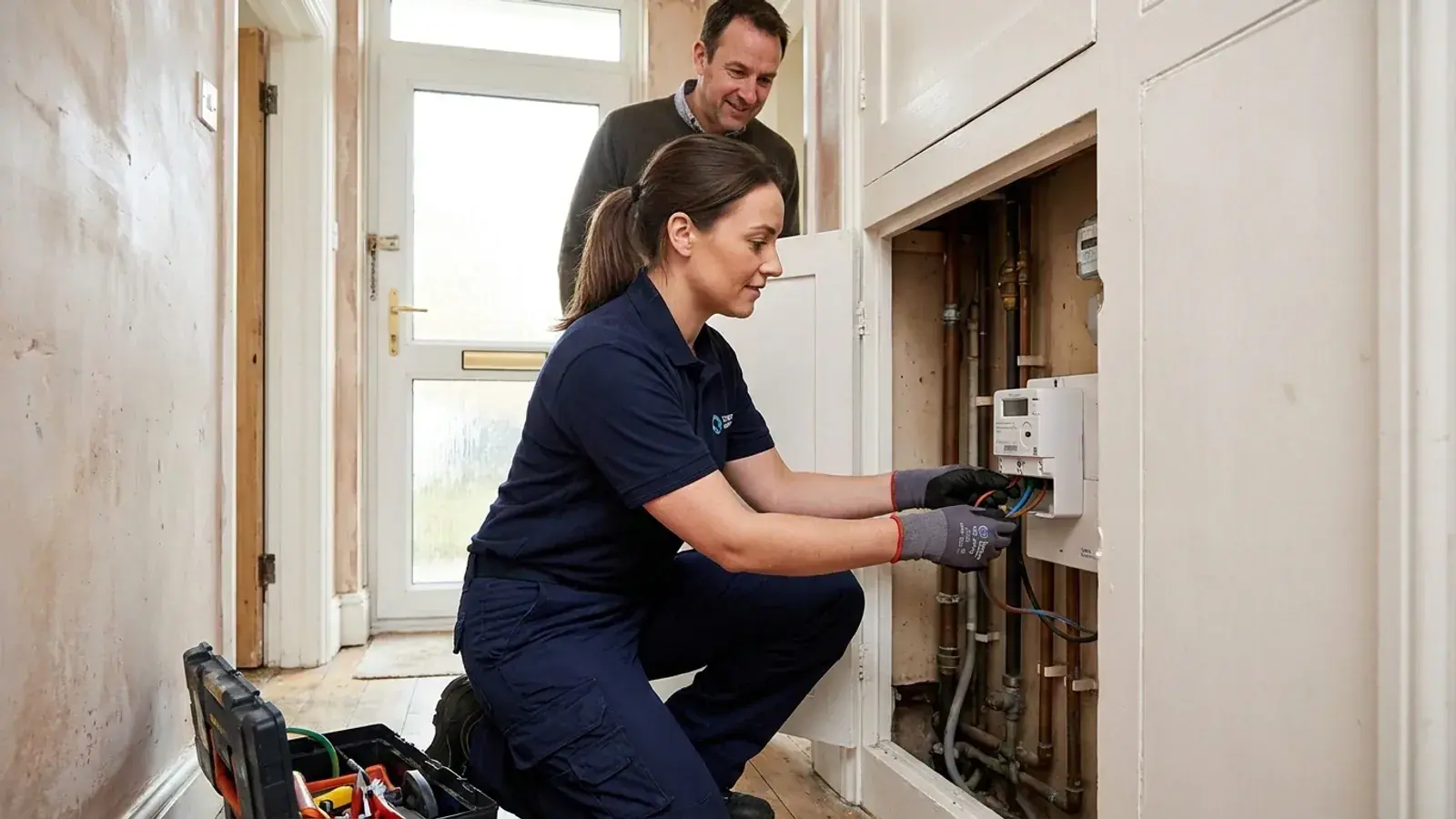
Smart meters are now common in Great Britain. In the latest official figures, covering the end of March 2026, around 39 million domestic smart meters had been installed, representing 72% of domestic meters. If you still have an older traditional meter, getting an upgrade is a straightforward process
Read guide →
Octopus Energy Refer a Friend Code – 2026
Octopus Energy runs one of the most popular refer-a-friend schemes in the UK energy market. While many suppliers stopped offering sign-up bonuses during the recent energy crisis, Octopus kept its scheme open. If you use a referral link from an existing customer to switch your gas or electricity, you
Read guide →
Average Gas and Electricity Bill for a Five Bedroom House (2026)
Living in a large five-bedroom house means you have more space to heat, more rooms to light, and usually more people using hot water and appliances. Because of this, your gas and electricity bills will be noticeably higher than the national average. When you hear news reports about the typical house
Read guide →
Written by
Rob Gibbs
Hi, I'm Rob, and I run Energy-Review.co.uk. I initially started this project in 2018 when I was looking to switch energy suppliers and found there wasn't a website that provided simple, data-backed reviews on all the suppliers available. Since then, I have spent a lot of time (too much, some may say!) looking at all publicly available data about each supplier and writing reviews using this information. These reviews are updated as regularly as possible, and any data is backed up by a source where necessary. I have also started writing guides on various energy-related topics, which hopefully you will find useful. If you find any issues, please use our contact form to let us know.